Piano Diagram of Bbm6/9 in Root Position
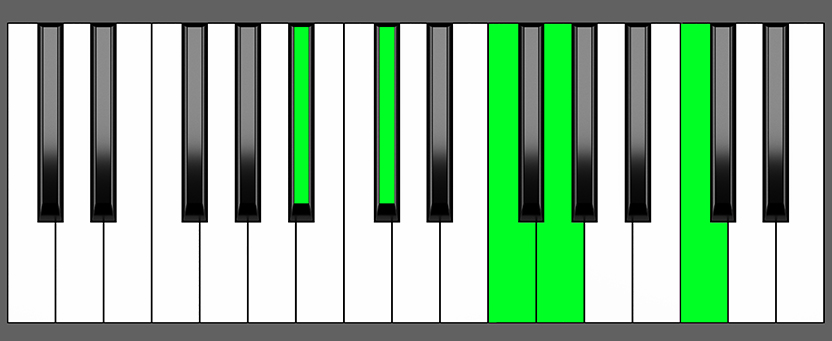
The Bbm6/9 chord is a minor chord based on the Bb key (Bb, Db, F) but with additional major 6th (G) and major 9th (C) intervals. In this article, we will explore the music theory behind this chord in greater detail.
Structure of Bbm6/9
Notes |
|---|
| Bb, Db, F, G, C |
Intervals |
|---|
| R, m3, 5, 6, 9 |
Bbm6/9 Chord Inversions
The Bbm6/9 chord has a total of 4 inversions:
| Root Position: | Bb | Db | F | G | C |
| 1st Inversion: | Db | F | G | Bb | C |
| 2nd Inversion: | F | G | Bb | C | Db |
| 3rd Inversion: | G | Bb | C | Db | F |
| 4th Inversion: | C | Db | F | G | Bb |
Piano Keyboard Diagrams
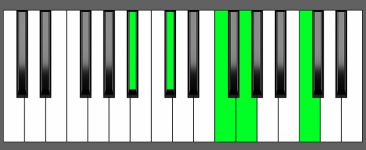
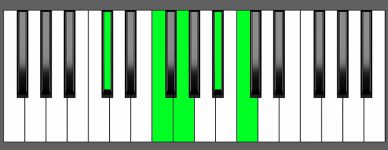
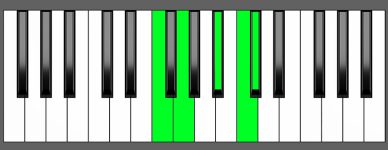
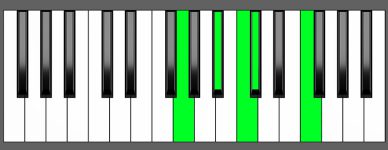
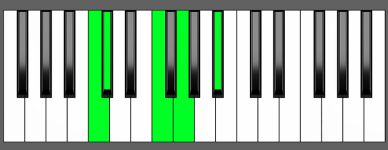
Playing Extended Chords on Piano
Extended chords like the m6/9 pack five notes into one shape, which gives a rich, full sound but can be a handful to play. The usual way to manage them is to leave out a note the ear can supply on its own – most often the 5th (F), sometimes the root (Bb) when a bass player or the left hand already covers it – or to split the chord between the hands. A clean Bbm6/9 voicing might put the root low in the left hand and the minor 3rd, 6th and 9th stacked in the right.
Because the chord has no 7th, its five notes spread across the keyboard without the density of a true extended chord, so it stays open and singable even in close position. Still, voicing it well takes some care: pile the notes too low and the minor 3rd against the 9th can turn muddy, so the added tones sound best kept up in the right hand.
Bbm6/9 as a Tonic minor voicing
The Bb minor sixth added ninth chord (Bbm6/9) is one of the most stable harmonic structures used in modal jazz, bossa nova, and film scoring to define a minor tonic completely free from the need for further resolution.
Built on the notes Bb, Db, F, G, and C, this chord deliberately omits the minor seventh, eliminating the friction and forward momentum that would typically pull the harmony toward a dominant chord. The juxtaposition of the minor third, which provides a dark and introspective foundation, with the bright, major intervals of the sixth and ninth generates a shimmering, open, and crystalline acoustic effect that directly evokes the sound of the Dorian mode.
Rather than serving as a vehicle to propel a progression forward, the Bbm6/9 acts as a definitive harmonic arrival point; it is frequently chosen as the final chord in minor-key pieces because it replaces the stark closure of a simple triad with a lingering, warm, and cinematic resonance that sustains without creating any urgency to move.
Music Theory and Harmony of Bbm6/9
Bbm6/9 is a Bb minor triad with two added tones: the major 6th (G) and the major 9th (C). Adding the major 6th to a minor chord ties it to the Dorian and melodic-minor sounds rather than the plainer natural minor, which is exactly why this chord is so strongly associated with the tonic-minor sound in jazz and bossa nova. The 6th sits a whole tone above the 5th and forms a tritone with the minor 3rd, giving the chord a subtle inner tension inside an otherwise restful minor sound.
Building the Bbm6/9 Chord: Different Approaches
Starting from the Bb Major Scale
To build a minor 6/9 chord you take the root, minor 3rd, 5th, major 6th and 9th. It can be clearer to show the construction from the major scale, because the major scale lays out the interval qualities plainly and you simply lower the 3rd.


Apply the formula R, m3, 5, 6, 9 to get a Bbm6/9 chord:
- Select the Root note, which is Bb.
- Pick the 3rd note, D, then lower it a half step to get the minor 3rd, Db.
- Add the 5th note, which is F.
- Now add the 6th, which is G.
- Lastly, include the 9th, which is C (the 2nd an octave higher).
by Combining Intervals
Another way to build a minor 6/9 chord is to stack specific intervals from the root up: a minor 3rd, a major 3rd, a major 2nd (whole tone), and a perfect 4th.
m3 + 3 + 2 + 4 = m6/9 Chord
In a Bbm6/9 chord you can see that
- Bb-Db forms a minor 3rd,
- Db-F creates a major 3rd,
- F-G makes a whole-tone interval, and
- G-C is a perfect 4th.
Stacking these intervals together creates a Bbm6/9 chord.
How to Use Bbm6/9 in a Chord Progression
The minor 6/9 is above all a tonic-minor chord. Because it adds the major 6th and 9th to a minor triad and has no 7th, it carries the Dorian and melodic-minor colour that jazz and bossa nova use for a minor home chord. It is most convincing where a minor key comes to rest, and it can also work as a coloured subdominant minor (iv) or as a Dorian-flavoured supertonic (ii) in a major key. Its G (the major 6th) is the note that decides everything: where the G belongs to the surrounding scale the chord sounds diatonic and settled; where it does not, the chord becomes a chromatic colour instead.
In every progression below the Bbm6/9 is written on its own, exactly where you would play it. The green cell is always the Bbm6/9 in context, and the roman numerals above each table show the underlying function.
on Natural minor Scales
| Minor Scales | i | ii | III | iv | v | VI | VII |
|---|---|---|---|---|---|---|---|
| Bb | Bb min7 ⇒ Bbm6/9 | Cm7b5 | Db Maj7 | Eb min7 | F min7 | Gb Maj7 | Ab7 |
| F | F min7 | Gm7b5 | Ab Maj7 | Bb min7 ⇒ Bbm6/9 | C min7 | Db Maj7 | Eb7 |
| Eb | Eb min7 | Fm7b5 | Gb Maj7 | Ab min7 | Bb min7 ⇒ Bbm6/9 | Cb Maj7 | Db7 |
- Tonic minor chord (i) in Bb minor
- Subdominant chord (iv) in F minor
- Non-diatonic dominant-position chord (v) in Eb minor
on Major Scales
| Major Scales | I | ii | iii | IV | V | vi | vii |
|---|---|---|---|---|---|---|---|
| Ab | Ab Maj7 | Bb min7 ⇒ Bbm6/9 | C min7 | Db Maj7 | Eb7 | F min7 | Gm7b5 |
| Gb | Gb Maj7 | Ab min7 | Bb min7 ⇒ Bbm6/9 | Cb Maj7 | Db7 | Eb min7 | Fm7b5 |
| Db | Db Maj7 | Eb min7 | F min7 | Gb Maj7 | Ab7 | Bb min7 ⇒ Bbm6/9 | Cm7b5 |
- Supertonic chord (ii) in Ab Major
- Non-diatonic mediant chord (iii) in Gb Major
- Non-diatonic submediant chord (vi) in Db Major
Bbm6/9 as the Tonic Minor (i) in Bb minor
This is the chord’s home ground. As the tonic of Bb minor, Bbm6/9 is the lush, settled minor chord that jazz and bossa nova reach for instead of a plain minor triad or a m7. The added 6th (G) comes from the Dorian and melodic-minor sounds, so the chord feels like a minor key at rest with a little inner glow rather than a chord that needs to move. It works best where the harmony arrives or sits: the final chord of a minor tune, a tonic vamp, or the top of a loop.
| i | ii | III | iv | v | VI | VII |
| Bb min7 ⇒ Bbm6/9 | Cm7b5 | Db Maj7 | Eb min7 | F min7 | Gb Maj7 | Ab7 |
Bbm6/9 Chord Progressions as i degree
Tonic-minor bossa vamp: i6/9 – iv
Two minor chords a fourth apart, neither pulling anywhere, with the rhythm supplying the motion – the minor-key counterpart of the classic bossa loop. Bbm6/9 sits as a warm, self-contained home chord.
| i6/9 | iv |
| Bbm6/9 | Eb min7 |
Minor line cliché: i – i(Maj7) – i7 – i6/9
The most idiomatic tonic-minor gesture of all: hold the Bb minor triad and walk the top voice down Bb – A – Ab – G. The last step lands on the 6th (G), turning the chord into Bbm6/9. This descending inner line is the sound of countless minor-key ballads and film cues.
| i | iΔ | i7 | i6/9 |
| Bb min | Bb mMaj7 | Bb min7 | Bbm6/9 |
i iv VII III
A descending minor progression that starts on the coloured tonic and moves down through the subdominant and the flat-side major chords. Bbm6/9 opens the phrase settled and rich before the harmony travels.
| i | iv | VII | III |
| Bbm6/9 | Eb min7 | Ab7 | Db Maj7 |
Dorian tonic: i6/9 – IV
The major 6th (G) is the note that turns Bb minor Dorian, and pairing the tonic with a major IV (built on that 6th degree, Eb major) is the classic Dorian move. The bright IV against the minor tonic is the “Santana” or “So What” colour, and Bbm6/9 already contains the note that makes it work.
| i6/9 | IV |
| Bbm6/9 | Eb7 |
Deceptive minor resolution: ii V i
Major ii–V: the ear expects to land on Bb Maj7 instead arrives on Bbm6/9. Because the two chords share the F, G and C, only the 3rd drops – D becomes Db – so the resolution feels like a sudden cooling of the harmony rather than a jarring change.
| ii | V | i |
| C min7 | F13 | Bbm6/9 |
Chromatic bebop turnaround: i VI7 bVI7 V7
Instead of the diatonic turnaround, this uses descending chromatic dominants. The G inside Bbm6/9 becomes the root of the G13 that follows – a secondary dominant (V7 of the ii) – triggering a chromatic chain of dominants down to the tonic dominant before the loop turns over.
| i | VI7 | bVI7 | V7 |
| Bbm6/9 | G13 | Gb13 | F7#9 |
Full minor cadence: i iv V i
The complete authentic minor cadence, with both the tonic and the subdominant voiced as 6/9 chords a fourth apart. The F7b9 is the quintessential minor-key dominant — its b9 (Gb) is the natural 6th degree of Bb minor, and together with the leading tone (A) it pulls hard back to the tonic. This is the m6/9 in its most functional, resolving setting, a contrast to the static vamps above.
| i | iv | V | i |
| Bbm6/9 | Ebm6/9 | F7b9 | Bbm6/9 |
Bbm6/9 as the Subdominant (iv) in F minor
Bbm6/9 also works as the subdominant (iv) of F minor. Here the chord’s 6th (G) is the 2nd degree of F minor, so it stays inside the key, and the minor iv gives that dark, plagal subdominant-minor colour. Moving a coloured iv toward the tonic is one of the most recognizable minor-key sounds.
| i | ii | III | iv | v | VI | VII |
| F min7 | Gm7b5 | Ab Maj7 | Bb min7 ⇒ Bbm6/9 | C min7 | Db Maj7 | Eb7 |
Bbm6/9 Chord Progressions as iv degree
i iv i
The plainest subdominant-minor motion: leave the tonic, colour the iv with the 6th and 9th, and return. The added tones keep the iv from sounding heavy, so the round trip feels smooth.
| i | iv | i |
| F min7 | Bbm6/9 | F min7 |
i iv V i
Minor cadence with the subdominant coloured as a 6/9. The iv sets up the dominant, and the added 6th and 9th give the approach a fuller, more modern sound before the resolution home.
| i | iv | V | i |
| F min7 | Bbm6/9 | C7 | F min7 |
VI iv i
Approaching the tonic from the submediant through the coloured iv gives a soft, plagal descent. Bbm6/9 as the middle chord adds warmth to the landing.
| VI | iv | i |
| Db Maj7 | Bbm6/9 | F min7 |
The same subdominant-minor sound is even more emotional when borrowed into a major key, where Bbm6/9 becomes the minor iv of F major. The next three progressions use it that way.
Extended minor plagal: I IV iv I
The romantic move par excellence. Bb Maj9 and Bbm6/9 differ only by the 3rd – D becomes Db – while the C (9th) and F (5th) stay put, and the G (6th) of Bbm6/9 anticipates the 9th of the returning F. The minor iv melts back into the tonic.
| I | IV | iv | I |
| F Maj9 | Bb Maj9 | Bbm6/9 | F Maj9 |
Backdoor cadence: ii iv bVII I
A film-scoring and classic-jazz substitution. Bbm6/9 sets up the flat-VII dominant on the way to the major tonic. In fact Bbm6/9 and Eb13 are nearly the same chord: put an Eb under a Bbm6/9 and you get an Eb13, so the move to Eb13 is almost a bass change.
| ii | iv | bVII | I |
| Gm11 | Bbm6/9 | Eb13 | F Maj7 |
Chromatic submediant approach: VI iv I
Common in Rhythm & Blues and gospel: an abrupt jump from a major VI to the minor iv, softened by the extensions of Bbm6/9, which prepares the ground gently for the tonic.
| VI | iv | I |
| D Maj7 | Bbm6/9 | F Maj7 |
Bbm6/9 as the Supertonic (ii) in Ab Major
The Bbm6/9 can also appear as the supertonic (ii) chord in Ab major, leading into the dominant in a coloured ii–V–I. Here the 6th (G) is the major 7th of Ab, so it belongs firmly to the key and gives the ii a fuller, Dorian-tinged sound than a plain minor triad. This is a very common jazz voicing for the ii of a ii–V.
Note that this use overlaps with the tonic-minor sound: a Bbm6/9 heard as ii of Ab and a Bbm6/9 heard as the tonic of Bb minor share the same notes, so context and bass motion decide which one the ear hears.
| I | ii | iii | IV | V | vi | vii |
| Ab Maj7 | Bb min7 ⇒ Bbm6/9 | C min7 | Db Maj7 | Eb7 | F min7 | Gm7b5 |
Bbm6/9 Chord Progressions as ii degree
Modern Dorian ii V I
The core jazz cadence with a coloured supertonic. The friction between the major 6th of Bbm6/9 (G) and the flat 9th of the Eb7b9 (Fb) builds a strong tension curve: the G falls to Fb, which in turn resolves to Eb, the 5th of Ab Maj9.
| ii | V | I |
| Bbm6/9 | Eb7b9 | Ab Maj9 |
iii vi ii V I
The extended turnaround keeps Bbm6/9 in its supertonic role while cycling through the diatonic chords back to the tonic, a common way to fill a turnaround without losing the ii–V pull.
| iii | vi | ii | V | I |
| C min7 | F min7 | Bbm6/9 | Eb7 | Ab Maj7 |
I vi ii V
The workhorse turnaround with the ii coloured as a 6/9. Bbm6/9 brings a richer supertonic into the loop without changing its function.
| I | vi | ii | V |
| Ab Maj7 | F min7 | Bbm6/9 | Eb7 |
Tritone ii subV I
The tritone substitution of the dominant. The A7#9 shares its core with Eb7, and the bass falls chromatically Bb – A – Ab while the upper structure of Bbm6/9 slides into the tonic with minimal movement.
| ii | subV | I |
| Bbm6/9 | A7#9 | Ab Maj7 |
Modal “So What” vamp: ii iii ii I
Blocks of the same voicing moved up and down the keyboard. Using the 6/9 shape instead of a plain m7 keeps the modal vamp open and airy rather than heavy.
| ii | iii | ii | I |
| Bbm6/9 | Cm11 | Bbm6/9 | Ab Maj7 |
Bbm6/9 in Other Positions
Beyond its main roles as a tonic minor, a subdominant iv, and a coloured Dorian ii, the Bbm6/9 can be written on other scale degrees, but these uses are far less common in real music. As the v of Eb minor, the iii of Gb major, or the vi of Db major, the chord’s 6th (G) lies outside the key, so it no longer sounds like a settled diatonic harmony. In those spots the G works as a chromatic passing colour rather than a stable chord tone.
In practice most writers reach for a plain minor 7th on those degrees and keep the minor 6/9 for the tonic-minor and subdominant sounds, where its major 6th does real harmonic work. If you do place a Bbm6/9 in one of these positions, treat the G as a deliberate voice-leading choice and check it against the melody so the out-of-key note is heard as colour, not as a wrong note.
| Key | Position | Out-of-key note |
| Eb minor | v | G (natural 6th) |
| Gb Major | iii | G (natural) |
| Db Major | vi | G (natural) |
Signature m6/9 Progressions Across Styles
Beyond the scale-degree view, the minor 6/9 turns up in a handful of instantly recognizable moves. These cut across keys and genres and are the fastest way to get the sound into your playing. Each is shown with Bb as the home chord.
Tonic-minor bossa: the i6/9 – ivm7 loop
Two minor chords a fourth apart, resting rather than resolving while the samba rhythm carries the motion – the minor-key version of the classic bossa loop, and a signature Jobim-era tonic-minor sound.
| i6/9 | ivm7 |
| Bbm6/9 | Eb min7 |
Parallel m6/9 planing
Keep the m6/9 shape and slide it in parallel. With no 7th to clash, whole-step planing sounds smooth – a common colour in film scoring and modal jazz.
| i6/9 | bVII6/9 | i6/9 | bVII6/9 |
| Bbm6/9 | Abm6/9 | Bbm6/9 | Abm6/9 |
Chromatic Rhythm & Blues approach
Sliding onto the target chord from a half step above is a neo-soul trademark. Because the shape has no tritone, the approach chord a semitone up drops cleanly onto Bbm6/9.
| bII6/9 | i6/9 |
| Cbm6/9 | Bbm6/9 |
Minor-thirds cycle (Coltrane matrix)
Dividing the octave into minor thirds using only m6/9 chords produces a modern, floating sound where the key dissolves but the intervallic structure stays strict. Four equal steps return home.
| i6/9 | biii6/9 | bv6/9 | vi6/9 |
| Bbm6/9 | Dbm6/9 | Fbm6/9 | Gm6/9 |
The resolved minor ending: iiø V i6/9
The most common practical use of a minor 6/9: land a minor ii–V on it as the very last chord, ending the tune warm and finished instead of on a bare minor triad. Standard in jazz and bossa.
| iiø | V | i6/9 |
| Cm7b5 | F7 | Bbm6/9 |
Static minor vamp
G minor 6/9 makes a perfect static vamp – colorful yet stable enough to sit on for a long stretch. Groove on it, or nudge down a whole step and back for motion without leaving home.
| i6/9 | bVII6/9 |
| Bbm6/9 | Abm6/9 |
Rootless Substitutions: Bbm6/9 Over Other Bass Notes
The real magic of the Bbm6/9 shows up when a bass player sounds a note other than Bb. Because the chord has no harsh tritone inside it, the same five notes – Bb, Db, F, G, C – become high-level extensions of several other chords depending on the bass. This makes the m6/9 a favorite rootless voicing: learn one shape and it serves many functions.
| Bass note | Resulting chord | Function |
| Eb | Eb13 | Dominant 13. Bb is the 5th, Db the b7, F the 9th, G the major 3rd, C the 13th – a full, suspended-sounding dominant. |
| A | A7#9 | Altered dominant. Bb is the b9, Db the major 3rd, G the b7, C the #9 – ideal resolving to D Maj7 or D min7. |
| Db | Db Maj13 | Lydian major tonic. Bb is the 13th, F the 3rd, G the raised 11th, C the major 7th – a floating, stellar sound. |
| G | Gm7b5 | Half-diminished (with the 11th, C, on top). Bb is the b3, Db the b5, F the b7 – substitutes for a m7b5 in an F-minor ii–V–i. |
| C | C7sus4 | Suspended Phrygian dominant (with a flat 9th, Db). Bb is the b7, F the 11th (sus4), G the 5th – a strong Spanish/Middle-Eastern colour. |
Two of these are worth singling out. Over Eb, the Bbm6/9 becomes an Eb13 – so a Bbm6/9 moving to an Eb chord is almost just a bass change, which is exactly why the backdoor cadence shown earlier works so smoothly. Over Db (the relative major), the same notes turn into a lush Db Maj13 with a Lydian raised 11th, tying the minor tonic to its relative major with no movement in the upper voices at all.
Alternative Names for Bbm6/9
- Bb -6/9
- Sib -6/9
- Bb m6/9
- Bb m6/9th
- Bb min 6/9
- Bb m9(add6)
- Bb min9 add 6
- Bb minor 6th 9th
- Bb minor sixth-ninth
Conclusion
The progressions in this article cover the most common and idiomatic uses of the Bb minor 6/9 chord: above all as a tonic minor in the Dorian and melodic-minor sense, as a coloured subdominant iv, and as a Dorian-flavoured supertonic ii in a major key. Its major 6th is what gives the chord its character, tying it to the jazz and bossa-nova minor sound, and it is also what makes the chord sound out of place on scale degrees where that note leaves the key. Keep the added tones up in the right hand, use the chord where a minor key comes to rest, and the m6/9 gives you one of the richest tonic-minor sounds in music.