Piano Diagram of Eb13 in Root Position
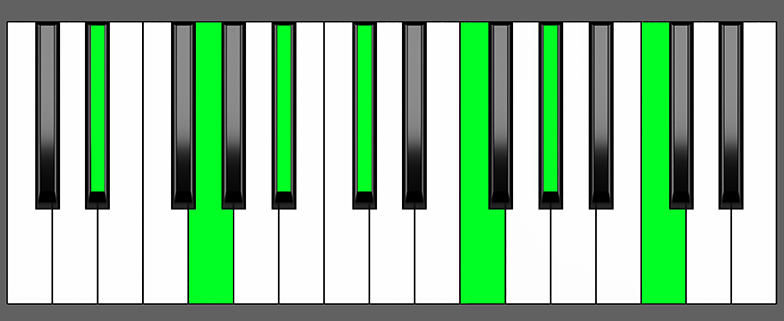
Eb13 is a chord that includes the root note Eb, a major third (G), a perfect fifth (Bb), a minor seventh (Db), a major ninth (F), an eleventh (Ab), and a 13th (C). It’s similar to a 6th chord since the 13th is a 6th at a higher octave but also includes a minor 7th, major 9th, and 11th.
Structure of Eb13
Notes |
|---|
| Eb, G, Bb, Db, F, Ab, C |
Intervals |
|---|
| R, 3, 5, m7, 9, 11, 13 |
Playing Extended Chords on Piano
Extended chords like the 13th pack a lot of notes into one grip, so pianists rarely play them note for note. The art is in choosing which tones to keep and which to leave out, and in spreading what remains across both hands so the chord sounds full without turning to mud. Everything below shows how to do that with Eb13 specifically.
Because a full Eb13 has seven notes and only a handful of them carry its identity, learning the chord really means learning which notes to leave out. Two of them can almost always go. The 5th (Bb) adds nothing to a dominant chord’s quality and is the first to be dropped. The 11th (Ab) clashes with the 3rd and is omitted unless you specifically want a suspended sound. That already trims the chord from seven notes to five: root, 3rd, flat 7th, 9th and 13th – and the two that truly matter are the 3rd (G) and the flat 7th (Db), the tritone pair that makes the chord dominant, coloured by the 13th (C) on top.
The Two-Handed Spread
The simplest full-sounding approach splits the work between the hands. The left hand anchors the harmony with the root and flat 7th (Eb and Db), while the right hand plays the colour tones – the 9th, the (optional) 11th and the 13th – with the 5th left out. Spreading the chord this way opens up the sound: the low root grounds it, the guide tones define it, and the extensions ring clearly on top instead of fighting each other in a cluster. This is the most reliable way to make a single Eb13 sound rich and complete under two hands.
Two compact shapes work especially well. In the first, the left hand holds the root while the right hand takes the flat 7th, the 9th and the 13th – four notes that already spell the chord’s character:
Eb + Db, F, C
In the second, the right hand plays a small inversion built from the flat 7th, the 3rd and the 13th over the same left-hand root, which puts the defining tritone right under your fingers:
Eb + Db, G, C
Both keep the root at the bottom and the bright 13th on top, and both leave out the 5th and the 11th so the sound stays open rather than crowded.
Rootless Voicings
The sound most people associate with jazz piano comes from the rootless voicings developed in the 1950s by players such as Bill Evans, Red Garland and Wynton Kelly. The idea is to hand the root to the bassist – or simply let the ear supply it – and use those freed-up fingers for colour tones instead, packing a compact four-note shape into the middle of the keyboard where it sounds warmest.
For a dominant thirteenth there are two classic shapes, and they are worth memorising because they are the backbone of jazz comping. The trick that turns an ordinary dominant into a thirteenth is to replace the 5th with the 13th and the root with the 9th:
- Type A (built from the 3rd): G, C, Db, F – that is the 3rd, 13th, flat 7th and 9th of Eb13.
- Type B (built from the flat 7th): Db, F, G, C – the flat 7th, 9th, 3rd and 13th.
The two shapes are the same four notes in a different order, one sitting roughly a fourth above the other. Their value shows up in a ii–V–I: if the ii chord uses a Type A shape and the Eb13 answers with a Type B shape (or vice versa), the inner voices barely move between chords – a note or two shifts by a half-step while the rest stay put. That minimal motion is the smooth, connected sound that makes a progression feel like one flowing idea rather than three separate grabs at the keys.
Playing Eb13 without a Bassist
Rootless voicings assume someone else is sounding the root. Alone at the piano the shape is technically incomplete, so pianists imply the missing Eb: a common trick is to tap the root low in the left hand on the first beat, almost like a stride bass, then release it and let the rootless voicing carry the rest of the bar. Once the ear has been told where home is, it happily fills in the root for the chords that follow, and the voicing sounds complete even though the root is no longer being played.
Eb13 Chord Inversions
The Eb13 chord has a total of 6 inversions:
| Root Position: | Eb | G | Bb | Db | F | Ab | C |
| 1st Inversion: | G | Bb | Db | Eb | F | Ab | C |
| 2nd Inversion: | Bb | Db | Eb | F | G | Ab | C |
| 3rd Inversion: | Db | Eb | F | G | Ab | Bb | C |
| 4th Inversion: | F | G | Ab | Bb | C | Db | Eb |
| 5th Inversion | Ab | Bb | C | Db | Eb | F | G |
| 6th Inversion | C | Db | Eb | F | G | Ab | Bb |
Piano Keyboard Diagrams
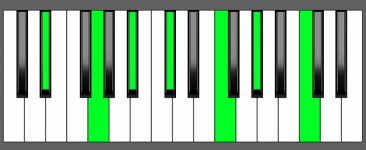
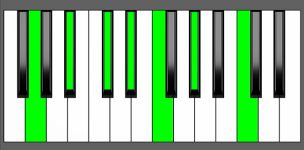
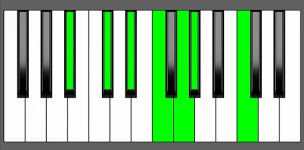
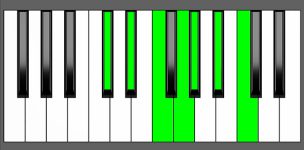
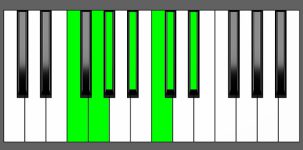
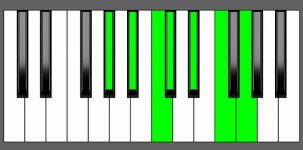
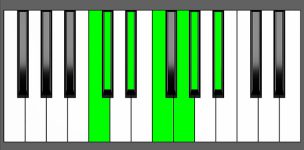
Chord Inversions on Piano
An inversion simply means taking the lowest note of the chord and moving it up an octave, so that a different chord tone sits in the bass. A plain triad has three inversions; a seventh chord has four. A thirteenth chord, though, is a different animal entirely, and this is where the idea of inversions starts to strain.
The reason is size. A complete Eb13 stacks seven different notes – Eb, G, Bb, Db, F, Ab and C – which is every note of a major scale sounded at once. Ten fingers cannot comfortably place seven notes in a tidy stack, and even if they could, cramming all seven into one octave produces a dense, muddy cluster rather than the bright, open sound the chord is prized for. In particular the 11th (Ab) sits a half-step above the 3rd (G), and that clash is so harsh that the 11th is almost always left out of a dominant thirteenth unless the chord is deliberately voiced as a suspension.
So the inversion diagrams below are best read as a map of the chord’s anatomy rather than as literal hand positions. They show the order in which the notes stack up – root position starting on Eb, first inversion starting on G, and so on – which is invaluable for understanding how the chord is built and how its voices move. But at the keyboard you will rarely play them as drawn.
What pianists actually do is thin the chord out and spread it across both hands, keeping the notes that define its character and dropping the ones that do not. The next section shows exactly which notes to keep and which to discard, and why a well-chosen four- or five-note voicing sounds fuller than the complete seven-note stack ever could.
Music Theory and Harmony of Eb13
The Eb13 chord is an extension of the Eb7 chord and shares its dominant function, so it can stand in for Eb7 wherever Eb7 appears – most naturally as the V chord of a major key. Because it carries a natural 13th (C), it leans toward a major resolution: a dominant that resolves to a minor chord usually darkens that top note, lowering the 13th instead. It can therefore be played in most of the positions where Eb7 works, but it is at its best pointing to a major tonic, and some positions will suit it better than others.
If you want to experiment with using Eb13 as an alternative to Eb7, you can start by checking out the Eb7 chord page for ideas on where to begin. Trying out the Eb13 chord in different positions can help you understand which ones work well and which ones may not be as effective.
Building the Eb13 Chord: Different Approaches
Starting from the Eb Major Scale
To form a 13th chord, you combine the root, the major 3rd, the 5th, the minor 7th, the major 9th, the 11th, and the 13th from a major scale.


To create the Eb13 chord, apply the formula R, 3, 5, m7, 9, 11, 13 in the following way:
- Begin with the Root note, which is Eb.
- Select the major 3rd interval, G.
- Add the 5th interval, which is Bb.
- Add the minor 7th interval, Db.
- Add the major 9th, which is F.
- Add the 11th Ab, which is a 4th interval at the higher octave.
- Lastly, add the 13th (C), which is a 6th at a higher octave.
By following this simple formula, you can create a 13th chord from any major scale.
by Combining Intervals
One method to create a 13th chord is by combining specific intervals – a major 3rd, a minor 3rd, a minor 3rd, a major 3rd, and a minor 3rd. This is the formula:
3 + m3 + m3 + 3 + m3 + 3 = 13th Chords
Upon analysis of the Eb13 chord, we can note that:
- the interval between Eb and G is a major 3rd,
- between G and Bb there is a minor 3rd,
- between Bb and Db is a minor 3rd,
- between Db and F is a major 3rd,
- between F and Ab there is a minor 3rd,
- and finally, between Ab and C there is a major 3rd.
by Combining Chords
Another way to build 13th chords is by combining a major triad with a Maj 7th chord derived from its minor 7th, or by merging a dominant 7th chord with a minor triad that is based on its second interval.
Eb Major + Db Maj7 = Eb13
or
Eb7 + F min = Eb13
To build the Eb13 chord, you can blend the Eb Major triad with the Db Major chord, or Eb7 with F minor. When played together, these two chords produce the Eb13 chord.
Eb13 in Four-Voice Writing
Classical harmony ran into the same problem long before jazz did. Writing in 1952, Walter Piston noted that a true thirteenth chord built by stacking thirds is genuinely rare, precisely because seven notes will not fit into the four voices that traditional harmony works with. The solution the common-practice composers settled on is the same one jazz players reached independently: keep the root, 3rd, flat 7th and 13th, and drop the 5th, 9th and 11th. Those four notes are enough to spell the chord unmistakably.
There is also a strong convention about where the 13th goes and what it does. It usually sits in the top voice, and from there it resolves downward by the interval of a third into the tonic chord that follows. In the key of Ab that means the C on top of Eb13 steps down to the Ab of the tonic – though, as we saw earlier, that C is already a note of the Ab chord, so often it simply stays put and lets the other voices resolve around it. Either way, placing the 13th on top and letting it fall (or hold) into the resolution is the voice-leading habit that makes the chord sound purposeful rather than merely decorative.
Eb13 versus Eb6: Eb Common Confusion
Because the 13th and the 6th are the same pitch, the labels Eb13 and Eb6 look as though they ought to be related, and beginners often treat them as interchangeable. They are not. The difference lies in what sits underneath that shared note.
Eb6 is a simple, restful chord: the Eb major triad – Eb, G, Bb – with the 6th (C) added on top, four notes in all, and no flat 7th anywhere. It sounds stable and sweet, a chord to end on. Eb13 is a dominant chord: it contains the flat 7th (Db), and it is that flat 7th grinding against the 13th (C) a major seventh above it that gives the chord its restless, forward-leaning tension. In other words, the 6th in Eb6 is a soft finishing touch, while the 13th in Eb13 is the bright crown on a chord that is straining to resolve. If you hear a flat 7th, you are dealing with a thirteenth; if you do not, it is a sixth. Keeping the two apart is the single most useful distinction to master before using either chord.
How to Use Eb13 in a Chord Progression
Eb13 is a dominant chord: it keeps the whole skeleton of Eb7 – including the G and Db that form its restless tritone – and stacks the 9th (F), 11th (Ab) and 13th (C) on top. That tritone is what gives it its forward pull, so anywhere Eb7 leans toward a resolution, Eb13 can take its place and add a wider, glassier sheen. The one thing worth remembering is the colour of the 13th itself: C is a bright, major-leaning tone, so Eb13 sounds most at home aiming at a major chord. When a dominant is headed for a minor chord instead, players tend to darken that top note (writing Eb7#5, whose B is the same lowered-13th sound), and a few of the grids below use exactly that trick.
The tables that follow show every place the Eb dominant lives inside a key, followed by hands-on progressions grouped by the musical job Eb13 is doing – closing a cadence, hanging as a groove, sneaking in through the back door, and so on.
on Ab Major
| Major Scale | I | ii | iii | IV | V | vi | vii |
|---|---|---|---|---|---|---|---|
| Ab | Ab Maj7 | Bb min7 | C min7 | Db Maj7 | Eb7 ⇒ Eb13 | F min7 | Gm7b5 |
- Dominant chord in Ab Major
on F minor
In F minor the same Eb chord falls on the seventh degree, a whole tone under the tonic. With its natural 13th it behaves less like a true leading-tone chord and more like the dominant on loan from the relative major, Ab. It shines when it tips the music toward Ab or sets up a change of key, rather than dropping straight onto F minor.
| Natural Minor | i | ii | III | iv | v | VI | VII |
|---|---|---|---|---|---|---|---|
| F | F min7 | Gm7b5 | Ab Maj7 | Bb min7 | C min7 | Db Maj7 | Eb7 ⇒ Eb13 |
- Subtonic / dominant of the relative major (Ab Major)
Eb13 Chord Function in Major and Minor Keys
Understanding Scale Degrees
When we form chords from a scale, each note in the scale is given a specific degree that reflects its position within the scale. The degree of a note in a scale determines its function and the role it plays in the overall harmony of the music.
- Starting with the first degree of the scale, we have the Tonic chord. This chord serves as the foundation of the scale, providing a stable tonal center for the music. It’s like the “home base” of the music, and all melodies and harmonies are anchored to this chord.
- Moving on to the second degree, we have the Supertonic. This degree acts as a transitional note between the tonic and other notes in the scale, creating a sense of movement and flow in the melody or harmony.
- The third degree is the Mediant, which is located halfway between the tonic and dominant notes. This degree helps to establish whether the scale is major or minor and plays a critical role in determining the mood and emotional impact of the music.
- The fourth degree is the Subdominant, which complements the dominant and adds tension and resolution to the music. It creates a push-pull effect that keeps the listener engaged and interested.
- The fifth degree is the Dominant, which generates tension and a sense of expectation. It often acts as the climax of a musical phrase or section and is resolved by returning to the tonic.
- The sixth degree is the Submediant, which provides a sense of stability and restfulness to the music. It’s often used as a transition between the dominant and tonic, creating a feeling of calm and relaxation.
- Finally, we have the seventh degree, the Leading tone. This degree produces a strong sense of tension and a desire to resolve to the tonic. It’s often used to create a sense of resolution and completion in the melody or harmony.
Eb13 as the Dominant of Ab Major
This is the chord’s home turf. On the fifth degree of Ab major, Eb13 gathers tension over its tritone and hands it to the tonic. What makes the landing so soft is a coincidence of notes: the C sitting on top of Eb13 is already the third of Ab, so that voice never has to move at all – it just holds while everything around it settles.
| Major Scale | I | ii | iii | IV | V | vi | vii |
|---|---|---|---|---|---|---|---|
| Ab | Ab Maj7 | Bb min7 | C min7 | Db Maj7 | Eb13 | F min7 | Gm7b5 |
Eb13 Chord Progressions as V degree
In each grid the shaded cell is Eb13; the chords around it are drawn from the key of Ab major.
ii – V – I
| ii | V | I |
| Bb min7 | Eb13 | Ab Maj7 |
The bread-and-butter cadence. Bb min7 opens the door, Eb13 fills it with tension, and the shared C lets the chord melt into Ab Maj7 without the top voice budging.
ii – V – vi (a soft landing)
| ii | V | vi |
| Bb min7 | Eb13 | F min7 |
Here Eb13 refuses to go home and steps up to F min7 instead. The ear braces for Ab and gets its shadow, the relative minor – a gentle swerve that keeps a phrase spinning forward when you are not ready to end it.
I – IV – V
| I | IV | V |
| Ab Maj7 | Db Maj7 | Eb13 |
Parking the phrase on Eb13 leaves it wide open, hanging on the dominant so the loop swings back round to Ab. The extra ninth and thirteenth turn an ordinary three-chord turn into something with more glow.
I – vi – ii – V
| I | vi | ii | V |
| Ab Maj7 | F min7 | Bb min7 | Eb13 |
The old circle-of-fifths turnaround. Roots fall F–Bb–A by fifths straight into the dominant, and cresting on Eb13 makes the pull back to the top of the form feel richer than a bare Eb7 ever would.
Eb13 as a Funk Vamp
Strip a groove down until only one chord is left and that chord is very often a dominant thirteenth. Funk built its whole language this way: lock a single dominant into a tight, syncopated pocket and let the drums and bass do the travelling while the harmony stays put. The bright 9th and 13th are exactly the notes a guitar or clav digs into on the offbeats.
A one-chord vamp
| I13 | · | · | · |
| Eb13 | Eb13 | Eb13 | Eb13 |
Ride Eb13 for four, eight, sixteen bars – as long as the pocket holds. Nothing resolves, so the tension of the thirteenth never discharges; it just glows underneath the rhythm, which is the entire point of a vamp. Every cell here is the target chord.
For grit, rock the smooth thirteenth against the rawer sharp-nine on the same root:
Eb13 against Eb7#9
| I13 | I7#9 | I13 | I7#9 |
| Eb13 | Eb7#9 | Eb13 | Eb7#9 |
Flipping between the silk of the 13th and the buzz of the #9 keeps a static groove breathing. Eb13 stays the anchor; Eb7#9 is the same root wearing a sharper face, not a move to a new chord.
Eb13 as a Backdoor Dominant
Build a dominant thirteenth on the flat-seventh of a key and you get the “backdoor” approach – a way of arriving at the tonic from underneath instead of through the front-door dominant. In the key of F, Eb is that flat-seventh, so Eb13 slides up into F rather than falling onto it. The move is prized because one inner voice does something lovely: the Db inside Eb13 drops a half-step to C, the fifth of F, while the C already on top is a chord tone of the goal.
iv – bVII13 – I (in F)
| iv | bVII13 | I |
| Bb min7 | Eb13 | F Maj7 |
The borrowed Bb min7 greases the approach, then Eb13 walks up into F Maj7 through that half-step slip. F Maj7 and Bb min7 belong to other chord families and stay unshaded; Eb13 is the only target.
Even without the set-up chord, Eb13 alone gives that warm, side-door pull:
bVII13 – I
| bVII13 | I |
| Eb13 | F Maj7 |
Composers reach for this when the textbook dominant feels too on-the-nose – the resolution still lands, but it arrives from an unexpected angle.
Eb13 with a Cool-Jazz Twist
A favourite move in bossa and cool jazz is to let a dominant shimmer on its natural 13th and then darken that same top note before resolving, tracing a tiny chromatic line inside an otherwise still chord. Because the plugin’s dictionary spells the lowered thirteenth as a raised fifth (the same pitch), the grid below writes it Eb7#5.
ii – V13 – V(alt) – I
| ii | V13 | V7#5 | I |
| Bb min9 | Eb13 | Eb7#5 | Ab Maj9 |
The top voice steps down C → Cb (written as the #5, B) between Eb13 and Eb7#5, a single chromatic sigh, before the chord settles onto Ab. Eb13 is the target; Eb7#5 is the same dominant re-shaded, and Ab Maj9 is the resolution from another family.
Eb13 in Neo-Soul and Gospel
Modern soul and gospel players love to make a dominant arrive in slow motion. They hold a suspended version first – the fourth (Ab) standing in for the third – and only later let that suspension fall into place, so the chord seems to come into focus rather than simply appear. Since the plugin recognises a suspended dominant as Eb9sus4, that is how the held chord is written here; releasing it gives the full Eb13.
ii – Vsus – V13 – I
| ii | V9sus4 | V13 | I |
| Bb min9 | Eb9sus4 | Eb13 | Ab Maj9 |
Eb9sus4 hovers on the fourth for a beat; when that Ab slides down to G the chord blossoms into Eb13, sharpening the pull into Ab Maj9. The shaded cell is the Eb13 target; Eb9sus4 is the same dominant held in suspension.
Gospel comping often loops the two on their own as a groove before finally resolving:
Vsus – V13 (rocking figure)
| V9sus4 | V13 |
| Eb9sus4 | Eb13 |
Rocking Eb9sus4 to Eb13 and back gives that hovering, unhurried sound where the third keeps appearing and dissolving over a steady root in the bass.
Eb13 in a Blues
The blues is the dominant thirteenth’s oldest home. In a jazz-blues the I, IV and V chords are all dominant sevenths, and dressing them as thirteenths is standard practice – the bright 9th and 13th sit perfectly over the shuffle without softening the bluesy edge. In Eb, that means Eb13 on the I, Ab13 on the IV and Bb13 on the V.
I13 – IV13 – I13 – V13 (blues in Eb)
| I13 | IV13 | I13 | V13 |
| Eb13 | Ab13 | Eb13 | Bb13 |
Eb13 is the tonic and the home the whole form circles back to. Ab13 and Bb13 are the IV and V of the same key – the same 13th family, one on each side – shown un-shaded because only the Eb13 target is highlighted. Ride the shuffle and let each chord lean on its 9th and 13th.
The classic quick-change opens by touching the IV in the second bar before settling back:
I13 – IV13 – I13 – I13 (quick-change opening)
| I13 | IV13 | I13 | I13 |
| Eb13 | Ab13 | Eb13 | Eb13 |
Nudging up to Ab13 in bar two and dropping straight back to Eb13 is the signature blues move, and with thirteenths it takes on a warm, horn-section colour.
Eb13 in a Turnaround
At the end of a blues or a rhythm-changes chorus, a turnaround relaunches the form. Here the tonic itself is made a dominant – Eb13 – so it pushes forward instead of resting, then the progression cycles back through the VI, ii and V to set up the next chorus.
I13 – VI7 – ii – V13
| I13 | VI7 | ii | V13 |
| Eb13 | C7#9 | F min9 | Bb13 |
Eb13 kicks the turnaround off with dominant drive. C7#9 is the gritty secondary dominant pulling toward the ii, F min9 answers it, and Bb13 is the V that hands the music back to the top. Only Eb13 is highlighted; the C7#9, F min9 and Bb13 are the surrounding chords of the turnaround.
Eb13 as a Tritone Substitute
Because Eb13 shares its tritone (G–Db) with Bbb7, the two chords are interchangeable dominants – the tritone substitution prized in jazz and bossa nova. Used this way, Eb13 stands in for the dominant of Ebb, resolving down a half-step onto the Ebb (D) tonic and drawing a smooth chromatic bass line where a leap would otherwise sit.
ii – subV13 – I (tritone sub into Ebb)
| ii | bII13 | I |
| Fbm9 | Eb13 | Ebb Maj7 |
Instead of the expected Bbb7, Eb13 takes its place and slides chromatically down to Ebb Maj7, the bass stepping Eb → Ebb. The shared G–Db tritone is what lets the substitution work. Eb13 is the target; Fbm9 and Ebb Maj7 belong to other families and stay un-shaded.
Eb13 in a Chain of Dominants
One of the oldest uses of dominant thirteenths is the chain of dominants – the ragtime or “Sears-Roebuck” bridge heard in the middle eight of rhythm changes (I Got Rhythm, Sweet Georgia Brown). Each chord is the dominant of the next and resolves down a fifth, and voicing every link as a thirteenth gives the run a smooth, uniform sheen.
III13 – VI13 – II13 – V13 (cycle toward Ab)
| III13 | VI13 | II13 | V13 |
| C13 | F13 | Bb13 | Eb13 |
Reading toward the key of Ab, the roots fall by fifths C → F → Bb → Eb, each dominant pulling into the next, with Eb13 as the final link that would resolve on to Ab. Every chord is the same 13th family; only the Eb13 target is highlighted.
Scales and Improvisation over Eb13
Knowing the chord is only half the story; the other half is knowing what to play over it. Because a dominant thirteenth lays out almost every note of a scale inside the chord itself, the scale that fits it is rarely in doubt – the chord practically names its own scale.
The Home Scale: Eb Mixolydian
The natural home of a plain dominant thirteenth is the Mixolydian mode – a major scale with a lowered 7th. For Eb13 that scale is Eb Mixolydian (Eb, F, G, Ab, Bb, C, Db), which is simply the notes of the Ab major scale started from Eb. Line the scale up against the chord and the fit is exact: every chord tone of Eb13 is a note of Eb Mixolydian, and the two “extra” notes of the scale are the 4th (Ab, the 11th) and the 5th (Bb) that the chord tends to leave out. This is why Eb13 and Eb Mixolydian feel like two views of the same object – stack the scale in thirds and you get the chord; spread the chord into a line and you get the scale.
When the Chord Wants a Sharper Colour
If the 11th of a straight Mixolydian scale sounds too soft against the chord, players often reach for the Lydian dominant scale instead – a Mixolydian with a raised 4th. For Eb13 that raises the Ab to A, turning the awkward 11th into a bright sharp-11th and giving the chord an airier, more modern sheen. It is the scale of choice when Eb13 is coloured as a sharp-11 chord, and it is especially common when the chord is acting as a tritone substitute, where that raised note leads the ear smoothly toward the resolution.
Upper-Structure Triads
There is a shortcut that turns all this theory into something you can grab with one hand. Above the guide tones of Eb13 sits a complete, ordinary major triad made of the chord’s own extensions: the 9th (F), the sharp-11th (A) and the 13th (C) spell the F major triad. Play the tritone of Eb13 – the 3rd and flat 7th, G and Db – in the left hand, then drop the F major triad on top with the right, and you have a full, glittering Eb13 (with a sharp-11 colour) built from two shapes your hands already know. This “upper structure” approach, a staple of bebop-era pianists, is the fastest way to voice a rich thirteenth in real time: you are not thinking about seven individual notes, only a familiar triad floating above two guide tones.
Alternative Eb13 Nomenclature
- Eb 13
- Mib 13
- Eb 13th
- Eb 7/13
- Eb dominant 13 (dom13)
- Eb 7/9/11/13
- Eb dominant 13
- Eb dominant 13th
- Eb dominant thirteenth
Conclusion
Across these examples the Eb13 chord turns up wearing several hats – the bright dominant of Ab major, the tonic of a blues, a turnaround engine, a tritone substitute, a link in a chain of dominants, a groove that never resolves, a back-door route into F, a shimmering cool-jazz colour, and a suspension that blooms into place in gospel and neo-soul. In every setting it is the natural 13th (C) that gives the chord its open, modern light, and the single most useful thing to carry away is that this brightness wants a major goal: keep the 13th natural when you are heading somewhere major, and darken it when you are not. Everything past that – altered dominants, reharmonization, deeper voice leading – is a door this one chord opens.