Piano Diagram of G# aug in Root Position
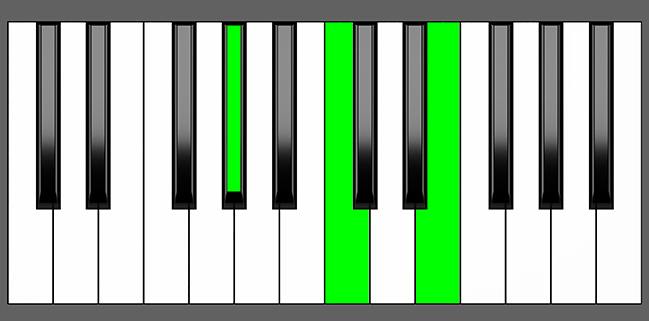
A G# augmented chord is an augmented triad built upon the key of G-sharp. To build a G# augmented chord, you combine the root (G#), the major 3rd (B#), and the “augmented” 5th note Dx (D “double sharp”, which is equivalent to E) from the G# scale. Keep reading to delve deeper into the music theory behind this chord.
Structure of G# aug
Notes |
|---|
| G#, B#, Dx |
Intervals |
|---|
| R, 3, #5 |
Fingers Position
Left Hand |
|---|
| 4, 2, 1
5, 3, 1 |
Right Hand |
|---|
| 1, 2, 4
1, 2, 5 |
G# aug Chord Inversions
G# aug has a total of 2 inversions:
| Root Position: | G# | B# | Dx |
| 1st Inversion: | B# | Dx | G# |
| 2nd Inversion: | Dx | G# | B# |
Piano Keyboard Diagrams
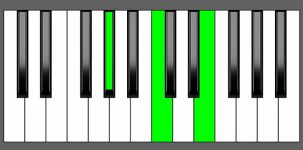
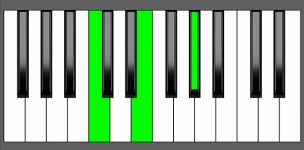
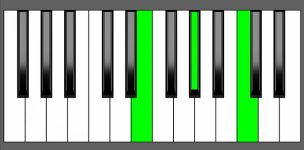
Inversions Equivalencies
One interesting feature of augmented chords is that each inversion of the chord produces a different augmented chord. For example, if you take the first inversion of a G# augmented chord, you get a B# (C) augmented chord. And if you take the second inversion of a G# augmented chord, you get a Dx (E) augmented chord.
So, you only really need four different augmented chords to cover all the possible keys, because all the other augmented chords can be found by inverting these four chords.
| Distinct aug Chords | Notes | Root Position | Enharmonic Inversions | |
|---|---|---|---|---|
| C aug | C – E – G# | C aug | E aug | G#/Ab aug |
| C# aug | C# – E# – Gx | C#/Db aug | F aug | A aug |
| D aug | D – F# – A# | D aug | F#/Gb aug | A#/Bb aug |
| D# aug | D# – Fx – Ax | D#/Eb aug | G aug | B aug |
Notice how each of the four distinct augmented chords contains a unique combination of three notes, which can be rearranged into three different chord inversions. By utilizing these four chords and their inversions, it’s possible to cover all 12 keys. Keep in mind that the selection of C, C#, D, and D# is arbitrary, as you could use any other series of unique augmented chords to build them all.
Music Theory and Harmony of G# aug
Augmented chords are typically found on the third degree of both the melodic and harmonic minor scales, where they are intended to function as mediant chords.
E# Melodic Minor Scale
| i | ii | III | IV | V | vi | vii |
| E# min | Fx min | G# aug | A# Maj | B# Maj | Cx dim | Dx dim |
E# Harmonic Minor Scale
| i | ii | III | iv | V | vi | vii |
| E# min | Fx dim | G# aug | A# min | B# Maj | C# dim | Dx dim |
However, in practice, they are not commonly used in this position. Instead, augmented chords are often used as a leading tone to resolve to a major or minor tonic chord.
But before we explore the chords that can follow a G# augmented chord, let’s take a closer look at how to build it.
Building the G# aug Chord: Different Approaches
Starting from the G# Major Scale
Keeping as reference the major scale, build the augmented chord, which consists of the Root, major 3rd, and sharp 5th.


- Start from the root note G-sharp.
- Add the major 3rd B# (C).
- Raise the 5th note, D# by one half-step to get Dx (E).
- Combine the root note G#, the major 3rd B#, and the augmented 5th Dx to form the G# augmented chord.
You can apply the formula R, 3, #5 to build any augmented chord.
by Combining 3rds
An augmented triad is a chord consisting of two stacked major 3rds.
3 + 3 = aug Chords
To build an augmented triad on G-sharp, you would start from the root note G#. Next, you would add a major third interval (four half steps) above G# to obtain the note C, which we call B# to preserve the basic chord structure. Finally, you would add another major third interval above B# to obtain the note Dx which is equivalent to E.
The resulting G# augmented triad would consist of the notes G#, B#, and Dx.
How to Use G# aug in a Chord Progression
The augmented triad earns its place in three ways: as a substitute for a dominant 7th chord, as a chromatic passing chord that connects two diatonic harmonies, and as a pivot that exploits its symmetry to slip between distant keys. All three uses rest on the same fact: because the chord is built from equal major 3rds, moving any single voice by a half step turns it into a familiar major or minor chord. That is what makes it such an efficient hinge between harmonies, so it’s worth seeing exactly which chords sit a half step away.
Resolving G# aug by Half-Step Voice Leading
Each of the three notes of G# aug (G#, B#, Dx) sits a half step away from a chord tone of some nearby major or minor triad. By lowering or raising one or two of its notes, the augmented chord resolves smoothly into six major and six minor triads. The tables below lay out those moves; they are best understood as voice-leading shortcuts, not as a catalogue to memorize.
Lowering One Note: G# aug to Major Chords
Lowering any single note of G# aug by a half step yields a major triad:
| aug Chord | Lowered Note | Resolving Chord | Chord Shape |
|---|---|---|---|
| G# B# Dx | G# | Fx B# Dx | 2nd inversion of B# Maj |
| B# | G# B E | 1st inversion of E Maj | |
| Dx | G# B# D# | Root position of G# Maj |
Lowering one note turns G# aug into G# Major, B# Major, or Dx (E) Major, one rooted on each note of the chord.
Lowering Two Notes: G# aug to minor Chords
Lowering two notes gives the three minor triads rooted on the same notes:
| aug Chord | Lowered Notes | Resolving Chord | Chord Shape |
|---|---|---|---|
| G# B# Dx | G#, Dx | Fx B# D# | 2nd inversion of B#m |
| G#, B# | G B E | 1st inversion of Em | |
| B#, Dx | G# B D# | Root position of G#m |
Lowering two notes gives G# minor, B# minor, or Dx (E) minor. This is useful in minor keys that borrow a V7 from the harmonic minor: G# aug can stand in for G#7, and, through its inversions, for B#7 and E7 as well. In practice the strongest fit is the augmented chord that shares its root with the dominant it replaces (G# aug for G#7); using it in place of B#7 or E7 really means using an inversion of B# aug or E aug.
Raising One Note: G# aug to minor Chords
Raising a single note gives three more minor triads:
| aug Chord | Raised Note | Resolving Chord | Chord Shape |
|---|---|---|---|
| G# B# Dx | G# | A C E | Root position of Am |
| B# | G# C# E | 2nd inversion of C#m | |
| Dx | G# B# E# | 1st inversion of E#m |
Raising one note gives Gx (A) minor, Bx (C#) minor, or E# minor.
Raising Two Notes: G# aug to Major Chords
Finally, raising two notes returns three major triads:
| aug Chord | Raised Notes | Resolving Chord | Chord Shape |
|---|---|---|---|
| G# B# Dx | B#, Dx | G# C# E# | 2nd inversion of C# Maj |
| G#, Dx | Gx B# E# | 1st inversion of E# Maj | |
| G#, B# | A C# E | Root position of A Maj |
Raising two notes gives Gx (A) Major, Bx (C#) Major, or E# Major. Taken together, the four tables show the augmented triad’s real advantage: from one symmetrical shape, a single half-step move reaches a dozen different triads.
G# aug as an Altered Dominant (V+)
The single most common use of the augmented triad is as an altered dominant. When G# aug functions as V+ in the key of C#, the augmented fifth (Dx) rises a half step to E#, the third of the tonic, while the root moves down a fifth in the usual way. The result is a dominant with an extra voice pulling toward the tonic, which sharpens the sense of resolution. Because G# aug shares its notes with B# aug and Dx/E aug, the same shape can act as the altered dominant in three keys at once, though the clearest reading is always the one where the augmented chord shares its root with the dominant it replaces.
The tables below place G# aug inside a ii–V–I, substituting it for the V chord. Try each progression both ways: plain dominant, then augmented, to hear what the raised fifth adds.
| G# aug in Major Keys | ||||
|---|---|---|---|---|
| Key | V degree | Substitution | ii V I | ii V+ I |
| in C# Major | G#7 | G# aug as Dominant (V+) | D#m | G#7 | C# Maj | D#m | G# aug (G#7) | C# Maj |
| in E# Major | B#7 | G# aug as Inversion of B# aug | Fxm | B#7 | E# Maj | Fxm | G# aug (B#7) | E# Maj |
| in Gx(A) Major* | Dx7(E7) | G# aug as Inversion of Dx aug | Bm | E7 | A Maj | Bm | G# aug (E7) | A Maj |
| in Fx(G) Major* | Cx7(D7) | Tritone substitution | Am | D7 | G Maj | Am | G# aug (D7) | G Maj |
*Since Gx and Fx Major are theoretical keys, we refer to their enharmonic equivalents, A and G Major.
- Resolving G# aug to C# major, the chord functions as V+ in C#. This is its most idiomatic use, a substitute for G#7 whose raised fifth (Dx) leans up into the third of C#. This is the same augmented lift heard in the verse of “Take the A Train” and in the opening bars of the Beatles’ “Michelle.”
- In E# major, G# aug substitutes for the V+ (B# aug) because it is an inversion of B# aug, which replaces B#7.
- Dx (E) aug is likewise an inversion of the same chord and can substitute as well, though it is usually clearer to use the augmented chord that shares its root with the dominant.
- Tritone substitution: replacing a dominant with a chord a tritone away keeps the dominant function while changing its color. G# aug can act as a tritone substitute for D7, since G# and D are a tritone apart.
| G# aug in minor Keys | ||||
|---|---|---|---|---|
| Key | V degree | Substitution | ii V i | ii V+ i |
| in C# minor | G#7 | G# aug as Dominant (V+) | D#ø | G#7 | C# min | D#ø | G# aug (G#7) | C# min |
| in E# minor | B#7 | G# aug as Inversion of B# aug | Fxø | B#7 | E# min | Fxø | G# aug (B#7) | E# min |
| in Gx(A) minor* | Dx7(E7) | G# aug as Inversion of Dx (E) aug | Bø | E7 | A min | Bø | G# aug (E7) | A min |
*Since Gx minor has 7 sharps, we refer to its enharmonic equivalent, A minor.
In minor keys the dominant is usually borrowed from the harmonic minor so that it carries a raised third; the augmented triad slots naturally into that role. Since G# aug shares its notes with B# aug and Dx aug, and each augmented chord can stand in for the dominant 7th on its own root, G# aug can replace G#7, B#7, or Dx7 in their respective keys, best of all when it keeps the same root as the dominant it stands for.
Minor ii – V+ – i with a 7#5 dominant (D#ø → G#7#5 → C#m)
Adding a b7 to the augmented triad gives a 7#5, the crunchiest altered dominant. This is the strongest way to hear G# aug pulling into C# minor, and it takes the whole-tone scale over the V chord.
| iiø | V+ | i |
| D#m7b5 | G#7#5 | C# min |
The augmented major-7th sound (G#Δ#5)
Adding a major 7th instead gives a maj7#5, a lush, floating colour favoured by writers like Wayne Shorter (heard throughout “Iris”). It works as a tonic or as a III+ borrowed from the melodic minor.
| IΔ#5 | IVΔ | iii | ii |
| G# Maj7#5 | C# Maj7 | B# min7 | A# min7 |
G# Maj7#5 is the G# augmented triad with a major 7th on top (G#, B#, Dx, Fx); here it colours the tonic before the phrase settles diatonically.
The augmented triad as an upper structure over a dominant
Jazz players also use the augmented triad as an upper structure: a bright triad shape in the right hand stacked over a dominant shell in the left. Over an F#7, for instance, augmented triads built on the root (F#) and on the 9th (G#) spell out an F#9#5, one of the most useful altered-dominant colours. The trick works because the augmented triad’s notes are all drawn from the whole-tone scale, the natural scale of a 7#5. One caution: because the augmented sound needs a natural 9th, it pairs with 9#5 but clashes with a b9 or #9, so it is not a substitute for every altered dominant.
G# aug as a Chromatic Passing Chord (the Augmented Line Cliché)
The second great use of the augmented triad is as a passing chord that harmonizes an ascending inner voice over a static bass. Hold a G# major chord and let one inner voice climb by half steps: D# (the fifth) rises to Dx (the augmented fifth of G# aug), then to E# (turning the chord into G#6), then on to F# (making G#7, a secondary dominant that leans toward the IV chord, C#). That single rising line, D# – Dx – E# – F#, is the augmented line cliché, and it is one of the most recognizable gestures in popular song.
Lesley Gore’s “It’s My Party” is a textbook case: its chorus runs G# – G#+ – C# – C#m, the augmented chord lifting the tonic straight into the subdominant. You also hear the device under sustained tonics in “Take the A Train,” in the Beatles’ “Oh! Darling” (which opens on an augmented V), and throughout the James Bond themes, where the raised fifth supplies that signature suspenseful lift. The progressions below show G# aug doing this work; each keeps A in the bass while the harmony brightens step by step.
| I | ii | iii | IV | V | vi | vii |
| G# Maj | A# min | B# min | C# Maj | D#7 | E# min | Fxdim |
Ascending line cliché (I → I+ → I6 → I7)
The complete rising line over a held G#, ending on a secondary dominant that pushes to the IV chord.
| I | I+ | I6 | I7 |
| G# Maj | G# aug | G#6 | G#7 |
The inner voice climbs D# → Dx → E# → F# while G# and B# stay put.
Extended line cliché into the subdominant (I → I+ → I6 → I7 → IV)
The full “Take the A Train” gesture: the rising line resolves onto IV, with the maj7 giving the arrival some weight.
| I | I+ | I6 | I7 | IVΔ |
| G# Maj | G# aug | G#6 | G#7 | C# Maj7 |
The G#7 acts as V7/IV, so the whole line D# → Dx → E# → F# lands naturally on C#.
Line cliché into the minor subdominant (I → I+ → I6 → iv)
The same rising line resolving into a minor iv. G# aug works as the passing chord: its Dx is the climbing inner voice on the way from the tonic to G#6, before the phrase settles on C# minor. This is the classic “My Funny Valentine” / James Bond inner-voice motion, and it is exactly the G#+ that hangs over the intro of the Beatles’ “I Want You (She’s So Heavy)” before dropping to C# minor.
| I | I+ | I6 | iv |
| G# Maj | G# aug | G#6 | C# min |
The rising fifth (D# → Dx → E#) drives the motion toward the borrowed minor iv.
ii – V+ – I with the augmented lift resolved (A#m7 → G# aug → C#Δ)
Instead of a bare three-chord turn, this places G# aug as a true V+ of C# inside a full ii–V–I, its Dx resolving up to E#.
| ii | V+ | IΔ |
| D# min7 | G# aug | C# Maj7 |
This is the ii–V–I from the table above, with the augmented fifth (Dx) rising a half step into E#, the third of C#.
G# aug as a Pivot: Modulating through Symmetry
Because G# aug belongs equally to three keys, it makes an ideal pivot for modulation. The same three notes can be heard as V+ of C#, of E#, or of Gx/A, so a single augmented chord can turn a corner into any of those areas without preparation. The simplest device is to sit on a static tonic and colour it with the augmented chord before moving on; it “adds interest to a series of static measures on a single chord,” as the older analyses put it. The turnaround below uses G# aug as a neighbour on both sides of a bright G#6, a compact way to animate a bar that would otherwise hold a single chord.
I I+ I6 I+ I
| I | I+ | I6 | I+ | I |
| G# Maj | G# aug | G#6 | G# aug | G# Maj |
G# aug in Famous Songs
Augmented triads are rare in popular music, which is exactly why they stand out when they appear. Songwriters reach for them at moments that need a lift, a hint of unease, or a strong pull toward the next chord. The examples below are shown in the same key as the rest of this article; in the original recordings they appear in whatever key the song happens to sit in, but the harmonic function is identical once transposed. Play each one, then swap the augmented chord for a plain major or dominant to hear exactly what the raised fifth contributes.
The doo-wop opener (the “Oh! Darling” gesture)
One of the most famous uses of an augmented triad in rock opens the Beatles’ “Oh! Darling”, where a V+ chord launches the vocal before the song settles into a doo-wop progression. Transposed so that G# aug is the dominant, the chord resolves up to the tonic a fourth above.
| V+ | I | V |
| G# aug | C# Maj | G# Maj |
The augmented fifth Dx rises a half step to E#, the third of the C# major tonic, driving the resolution.
The rising line cliché (the “(Just Like) Starting Over” gesture)
John Lennon’s “(Just Like) Starting Over” uses an augmented chord that arises from ascending chromatic motion over a held root, the tonic climbing to its sharpened fifth before moving on. This is the same ascending line cliché shown earlier, framed here as a real-song example.
| I | I+ | I6 |
| G# Maj | G# aug | G#6 |
D# rises to Dx then to E#, the tonic staying under the moving inner voice.
The descending line cliché (the “All My Loving” gesture)
The Beatles’ “All My Loving” features augmented colour in its harmony arising from a descending chromatic line. Reframed on a held G#, the fifth falls by half steps, the mirror image of the rising cliché above.
| I6 | I+ | I |
| G#6 | G# aug | G# Maj |
The fifth descends E# → E (Dx) → D#, creating the classic falling inner voice.
The hanging dominant (the “I Want You (She’s So Heavy)” gesture)
On Abbey Road, “I Want You (She’s So Heavy)” ends a section on a dramatic, unresolved augmented V chord that leaves the ear expecting a return to the minor tonic. Placed on the tonic’s dominant as V+, it hangs over the relative minor without resolving, all tension and no release.
| i | V+ | (…) |
| C# min | G# aug | — |
The chord is left hanging: Dx strains toward E# but never arrives, holding the listener in suspense.
Alternative Names for G# aug
- G#+
- G#+5
- G#aug
- G#(#5)
- G#(5#)
- G#(5+)
- G#(#5+)
- G#aug5
- G#(5aug)
- G#(+#5)
Conclusion
The augmented triad is a small chord with an outsized role. Its equal division of the octave means one shape covers three keys, its raised fifth makes it a natural altered dominant (V+), and its half-step voice leading lets it pass smoothly between diatonic chords or pivot into distant ones. The progressions here cover its core idiomatic uses: as a substitute dominant in ii–V–I, as the ascending line cliché over a static tonic (heard in “It’s My Party,” “Oh! Darling,” and countless film scores), and as a symmetric pivot. As an upper structure it also supplies the 9#5 altered-dominant colour prized in jazz. From these foundations the chord opens onto wider territory, including the whole-tone and augmented scales, the augmented major-7th sound favoured by writers like Wayne Shorter, and the three-tonic system behind “Giant Steps.”