Piano Diagram of E6/9 in Root Position
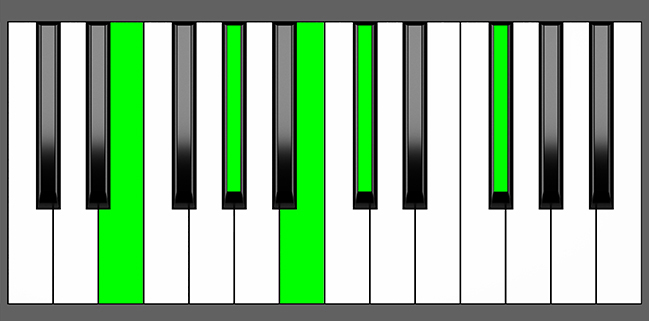
E6/9 is a five-note chord consisting of the notes E, G#, B, C#, and F#. It is a major chord with an added 6th and 9th. It belongs to the chord family of 6th chords, which are “Added chords”. Keep reading to gain a deeper understanding of the music theory behind this chord.
Structure of E6/9
Notes |
|---|
| E, G#, B, C#, F# |
Intervals |
|---|
| R, 3, 5, 6, 9 |
Playing Extended Chords on Piano
Extended chords are an essential part of piano playing, providing a rich and complex sound. However, playing extended chords can be challenging due to the number of notes involved. One way to manage this is by omitting certain notes, such as the root or the 5th, or by dividing the chord between both hands.
Despite these techniques, extended chords can still create dense harmonies that require careful voicing. When inverted, these chords can produce complex clusters of notes that need to be approached with skill and precision. Mastering the voicing of extended chords takes time and practice, but it’s a crucial skill for any pianist looking to expand their repertoire.
E6/9 Chord Inversions
The E6/9 chord has a total of 4 inversions:
| Root Position: | E | G# | B | C# | F# |
| 1st Inversion: | G# | B | C# | E | F# |
| 2nd Inversion: | B | C# | E | F# | G# |
| 3rd Inversion: | C# | E | F# | G# | B |
| 4th Inversion: | F# | G# | B | C# | E |
Piano Keyboard Diagrams
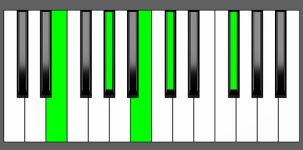
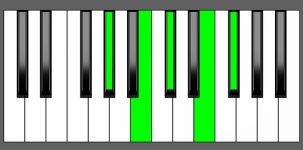
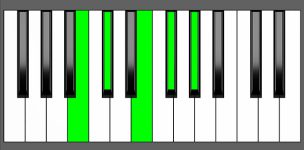
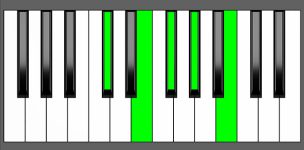
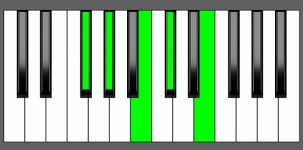
Chord Inversion on Piano
Chord inversions are a foundational concept in music theory, helping to explain how chords are built and how they fit into progressions. However, when we talk about chord inversions on a piano keyboard, it’s important to keep in mind that the diagrams we use to show the notes in an inversion might not always match up with practical playing.
In practice, pianists use different voicings and fingerings for chords, spreading the notes out across different octaves and positions on the keyboard. This means that the basic shape of a chord’s inversions as shown in diagrams might not always be the most efficient way to play the chord on a piano keyboard.
So while chord inversion diagrams can help understand the sequence of notes in a chord, they don’t always give us the best way to play the chord on a piano. It’s up to each pianist to experiment with different voicings and find the most comfortable and efficient way to play the chord while still maintaining the intended harmonic function and sound.
Music Theory and Harmony of E6/9
Building the E6/9 Chord: Different Approaches
Starting from the E Major Scale
To create a 6/9 chord, you can use the Major scale as a reference by combining a Root, a 3rd, a 5th, a 6th, and a 9th.
In this case, to build an E6/9 let’s start from the E Major scale:


Apply the formula R, 3, 5, 6, 9 to get an E6/9 chord:
- Select the Root note, which is E.
- Pick the 3rd note, which is G#, and add it to the chord.
- Add the 5th note, which is B, and include it as well.
- Now, add the 6th which is C#.
- Lastly, include the 9th note of the E Major scale, which is an F#.
by Combining Intervals
To build a 6/9 chord, one approach is to stack specific intervals from the root up, namely a major 3rd, a minor 3rd, a major 2nd (whole-tone), and a perfect 4th.
3 + m3 + 2 + 4 = 6/9 Chord
When constructing an E6/9 chord, you can see that
- E-G# forms a major 3rd,
- G#-B creates a minor 3rd,
- B-C# makes a whole-tone interval, and
- C#-F# is a perfect 4th.
Stacking these intervals together creates an E6/9 chord.
How to Use E6/9 in a Chord Progression
Because a 6/9 chord is built on a major triad with an added 6th and 9th and contains no 7th, it can stand in for the major chords that occur in a harmonized scale. This means we can place the E6/9 chord on any scale degree whose diatonic harmonization produces a major chord.
The missing 7th is the key to how flexible this chord is. Without a major 7th or a flat 7th to fix its identity, the E6/9 is harmonically ambiguous: the very same shape can imply a major (tonic-type) chord or a dominant chord depending on what surrounds it. In practice this means the E6/9 is used most often as a tonic substitute, very often as a subdominant, and occasionally as a soft dominant.
In every progression below the E6/9 is written on its own, exactly where you would play it — no “play this or that” shorthand. The green cell is always the E6/9 in context, and the roman numerals above each table show the underlying function.
on Major Scales
| Major Scales | I | ii | iii | IV | V | vi | vii |
|---|---|---|---|---|---|---|---|
| E | E Maj7 ⇒ E6/9 | F# min7 | G# min7 | A Maj7 | B7 | C# min7 | D#m7b5 |
| B | B Maj7 | C# min7 | D# min7 | E Maj7 ⇒ E6/9 | F#7 | G# min7 | A#m7b5 |
| A | A Maj7 | B min7 | C# min7 | D Maj7 | E7 ⇒ E6/9 | F# min7 | G#m7b5 |
- Tonic chord (I) in E Major
- Subdominant chord (IV) in B Major
- Dominant chord (V) in A Major (less common)
on Natural minor Scales
| Minor Scales | i | ii | III | iv | v | VI | VII |
|---|---|---|---|---|---|---|---|
| C# | C# min7 | D#m7b5 | E Maj7 ⇒ E6/9 | F# min7 | G# min7 | A Maj7 | B7 |
| G# | G# min7 | A#m7b5 | B Maj7 | C# min7 | D# min7 | E Maj7 ⇒ E6/9 | F#7 |
| F# | F# min7 | G#m7b5 | A Maj7 | B min7 | C# min7 | D Maj7 | E7 ⇒ E6/9 |
- Mediant chord (III) in C# minor
- Submediant chord (VI) in G# minor
- Subtonic chord (VII) in F# minor
Why the E6/9 Works So Well (and Why It’s Ambiguous)
A plain major triad can sound bare in jazz, bossa nova, soul and gospel, while a Maj7 chord adds a strong, sometimes “sweet” leading-tone. The E6/9 sits between these two options: it enriches the E major triad with two consonant color tones (the 6th, C#, and the 9th, F#) without the half-step tension of a major 7th. The result is a chord that sounds open, stable and resolved — which is exactly why it is such a popular way to end a piece.
The five notes E–G#–B–C#–F# are also the first five notes of the E major pentatonic scale stacked into one sonority. That is part of why the chord sounds so smooth and “singable”: every note belongs to the pentatonic, so nothing clashes. Stacked in fourths, the same notes give a quartal voicing, which is why the 6/9 also fits modern, fourth-based comping.
There is a trade-off to the missing 7th. Because the chord has no 7th, it does not announce whether it is functioning as a major (I) chord or as a dominant. In practice this is a feature, not a bug: it lets the same E6/9 shape act as a restful tonic in one place and a colorful dominant in another, and it lets you slide the chord around chromatically or in parallel motion without harsh functional clashes.
Voicing the E6/9 on Piano and Guitar
Five notes are a lot to hold at once, so the E6/9 is rarely played with all five voices bunched together. A close stack of E–G#–B–C#–F# tends to sound muddy low on the keyboard and is awkward on the guitar, so musicians voice the chord by choosing which notes to keep.
- Omit the 5th (B). The 5th adds little color and is the first note to drop. A four-note E6/9 without the 5th — E, G#, C#, F# — is bright and complete.
- Omit the root (E). When a bass player or the left hand covers the root, the right hand can play just G#, C#, F# (and optionally B). Rootless voicings are the norm in jazz comping.
- Split the chord between both hands. On piano, put E (and maybe B) in the left hand and stack G#, C#, F# in the right to spread the notes and clear the texture.
- Bass on the 5th. In bossa nova the B (the 5th) is very often placed in the bass, so the E6/9 is heard as a second-inversion voicing that alternates root and 5th in the bass.
On guitar the E6/9 is famously a movable shape: learn one fingering and you can slide it up and down the neck to reach every other 6/9 chord — one reason it is a staple of bossa nova rhythm guitar.
E6/9 Chord Function in Major and Minor Keys
Understanding Scale Degrees
When we harmonize a scale, we use the notes of the scale to create chords. This means that the notes of the chords are all found within the scale itself.
Each note in the scale is assigned a degree, which represents its position in the scale. The degrees of the harmonized diatonic major scale are as follows:
- Tonic (1st degree): serves as the tonal center or home base of the music and provides a sense of resolution and stability.
- Supertonic (2nd degree): often serves as a passing tone or a bridge between the tonic and other scale degrees.
- Mediant (3rd degree): helps to define the overall tonality of the scale (major or minor) and lies midway between the tonic and the dominant.
- Subdominant (4th degree): often used as a contrasting or complementary harmony to the dominant.
- Dominant (5th degree): creates tension and a sense of expectation, which is resolved when returning to the tonic.
- Submediant (6th degree): lies midway between the tonic and the subdominant and often serves as a bridge between the dominant and the tonic.
- Leading tone (7th degree): one half step below the tonic and creates a strong sense of tension and desire to resolve to the tonic.
E6/9 in E Major (as the I chord)
E6/9 replaces A or E Maj7 as the tonic of E major. As the I chord it is the point of rest, so it works best where the harmony arrives or sits: the last chord of a cadence, the top of a turnaround, or a lush tonic vamp. These are the progressions where a I6/9 sounds most natural.
| I | ii | iii | IV | V | vi | vii |
| E Maj7 ⇒ E6/9 | F# min7 | G# min7 | A Maj7 | B7 | C# min7 | D#m7b5 |
E6/9 as I degree – Chord Progressions
ii V I — the essential jazz resolution
The most idiomatic use of a I6/9: end a ii–V on it instead of a plain tonic.
| ii | V | I |
| F# min7 | B7 | E6/9 |
I vi ii V — turnaround
The workhorse turnaround; the I6/9 opens it feeling settled before the motion begins.
| I | vi | ii | V |
| E6/9 | C# min7 | F# min7 | B7 |
iii vi ii V — turnaround resolving to I
The iii–vi–ii–V pushes back to the top; land it on the I6/9.
| iii | vi | ii | V | I |
| G# min7 | C# min7 | F# min7 | B7 | E6/9 |
I VI7 ii V — turnaround with dominant VI
Making the vi a dominant (VI7) adds pull toward ii; a classic “rhythm changes” flavor.
| I | VI7 | ii | V |
| E6/9 | C#7 | F# min7 | B7 |
I6/9 IVmaj7 — bossa tonic loop
Two major-family chords a fourth apart, neither needing resolution — the signature bossa “rest” loop. Alternate E and B in the bass.
| I | IV |
| E6/9 | A Maj7 |
I6/9 ↔ II6/9 — parallel 6/9 slide
Slide the whole 6/9 shape up a whole step and back. Pure parallel motion — a favorite bossa and pop guitar move.
| I | II |
| E6/9 | F#6/9 |
I II7 ii V I — the “A Train” / “Ipanema” opening
Tonic, then a II7 (V of V), then a ii–V home. Bookend it with the I6/9.
| I | II7 | ii | V | I |
| E6/9 | F#7 | F# min7 | B7 | E6/9 |
I IV V I — classic cadence
The most basic strong cadence; the 6/9 gives the final tonic a modern sheen.
| I | IV | V | I |
| E6/9 | A Maj7 | B7 | E6/9 |
I V vi IV — pop progression
The ubiquitous pop loop; opening on a I6/9 gives it an airy, sophisticated lift.
| I | V | vi | IV |
| E6/9 | B7 | C# min7 | A Maj7 |
vi IV I V — pop, tonic as landing
Same four chords rotated so the I6/9 is the bright arrival after the minor vi.
| vi | IV | I | V |
| C# min7 | A Maj7 | E6/9 | B7 |
I6/9 — jazz blues in E (first four bars)
On a jazz blues the tonic is often a 6/9. Here are the opening bars with the quick IV.
| I | IV | I | I |
| E6/9 | A9 | E6/9 | E6/9 |
E6/9 in B Major (as the IV chord)
In B major, E6/9 is the subdominant (IV). The IV is the “away from home” chord that sets up either a return to the tonic (plagal) or a move to the dominant. E 6/9 here is lush but doesn’t pull hard, which is why the I–IV 6/9 loop and the plagal IV–I are such bossa and gospel staples.
| I | ii | iii | IV | V | vi | vii |
| B Maj7 | C# min7 | D# min7 | E Maj7 ⇒ E6/9 | F#7 | G# min7 | A#m7b5 |
E6/9 as IV degree – Chord Progressions
IV I — plagal “amen” cadence
The subdominant resolving straight home; a 6/9 IV makes the plagal move glow.
| IV | I |
| E6/9 | B Maj7 |
I IV6/9 — bossa tonic loop (from the IV side)
The same lush I–IV loop, here with the 6/9 on the subdominant.
| I | IV |
| B Maj7 | E6/9 |
I IV V — classic cadence
The subdominant as the middle step of the strongest cadence in tonal music.
| I | IV | V |
| B Maj7 | E6/9 | F#7 |
I IV ii V — subdominant into the ii-V
The IV6/9 flows down to ii, then a ii–V home.
| I | IV | ii | V |
| B Maj7 | E6/9 | C# min7 | F#7 |
I V vi IV — pop, 6/9 as the final IV
The pop loop landing on a colorful subdominant instead of the tonic.
| I | V | vi | IV |
| B Maj7 | F#7 | G# min7 | E6/9 |
vi IV I V — pop rotation
IV6/9 sits between the minor vi and the tonic for a smooth descent.
| vi | IV | I | V |
| G# min7 | E6/9 | B Maj7 | F#7 |
I vi IV V — 50s / doo-wop progression
The evergreen doo-wop changes; the 6/9 modernizes the subdominant.
| I | vi | IV | V |
| B Maj7 | G# min7 | E6/9 | F#7 |
IV V I — subdominant cadence into tonic
A direct IV–V–I with the 6/9 opening the cadence.
| IV | V | I |
| E6/9 | F#7 | B Maj7 |
E6/9 in A Major (as the V chord)
In A major, E6/9 stands on the dominant (V). It has no flat 7th, so it is a soft dominant — it colors the V and eases into the tonic rather than yanking toward it. This makes it lovely for gentle, bossa-flavored cadences where you want resolution without a hard pull. (For a stronger pull, a plain E7 or E13 is the usual choice.)
| I | ii | iii | IV | V | vi | vii |
| A Maj7 | B min7 | C# min7 | D Maj7 | E7 ⇒ E6/9 | F# min7 | G#m7b5 |
E6/9 as V degree – Chord Progressions
V I — soft authentic cadence
The dominant resolving home, softened by the 6/9 color.
| V | I |
| E6/9 | A Maj7 |
ii V I — the 6/9 as a gentle dominant
A ii–V–I where the V is a mellow 6/9 instead of a dominant 7th.
| ii | V | I |
| B min7 | E6/9 | A Maj7 |
I V — two-chord vamp
A relaxed tonic–dominant rock, with the dominant kept soft.
| I | V |
| A Maj7 | E6/9 |
I IV V — classic cadence, soft V
The strongest cadence, ending gently thanks to the 6/9 dominant.
| I | IV | V |
| A Maj7 | D Maj7 | E6/9 |
I vi IV V — doo-wop, ending on the 6/9
The 50s changes closing on a colorful, non-aggressive dominant.
| I | vi | IV | V |
| A Maj7 | F# min7 | D Maj7 | E6/9 |
I V vi IV — pop, soft dominant
The pop loop with the V as a 6/9 for a dreamier turn.
| I | V | vi | IV |
| A Maj7 | E6/9 | F# min7 | D Maj7 |
I IV ii V — into the turnaround
A full-bar walk that lands the 6/9 on the V, ready to loop back to I.
| I | IV | ii | V |
| A Maj7 | D Maj7 | B min7 | E6/9 |
E6/9 in C# minor (as the III chord)
In C# minor, E6/9 sits on the third degree — the relative major. It is the brightest diatonic chord in the key, so it lifts a minor progression toward its warm side, and it feels like a mini “home away from home.” It shines wherever a minor tune leans on its major III.
| i | ii | III | iv | v | VI | VII |
| C# min7 | D#m7b5 | E Maj7 ⇒ E6/9 | F# min7 | G# min7 | A Maj7 | B7 |
E6/9 as III degree – Chord Progressions
i III — minor to its relative major
The most direct way to hear the III6/9: straight from the tonic minor.
| i | III |
| C# min7 | E6/9 |
III VII i — relative-major approach home
Open on the bright III6/9, drop through VII, land on the minor tonic.
| III | VII | i |
| E6/9 | B7 | C# min7 |
i VI III VII — epic minor loop
A cinematic four-chord loop; the III6/9 is its shining moment.
| i | VI | III | VII |
| C# min7 | A Maj7 | E6/9 | B7 |
i III VII VI — descending minor loop
The 6/9 lands right after the tonic for an immediate lift.
| i | III | VII | VI |
| C# min7 | E6/9 | B7 | A Maj7 |
III iv i — plagal color into minor
The major III falling to the minor iv and home — a bittersweet turn.
| III | iv | i |
| E6/9 | F# min7 | C# min7 |
Circle Progression
The 6/9 as III inside a full circle-of-fifths run back to the tonic.
| i | iv | VII | III | VI | ii | V7 | i |
| C# min7 | F# min7 | B7 | E6/9 | A Maj7 | D#m7b5 | G#7 | C# min7 |
E6/9 in G# minor (as the VI chord)
In G# minor, E6/9 is the submediant (VI) — one of the most-used resting points in minor-key pop, rock and film music. E 6/9 there gives a warm, cinematic swell, and it is the natural “color” chord in the hugely common i–VI–VII and i–VII–VI loops.
| i | ii | III | iv | v | VI | VII |
| G# min7 | A#m7b5 | B Maj7 | C# min7 | D# min7 | E Maj7 ⇒ E6/9 | F#7 |
E6/9 as VI degree – Chord Progressions
i VI VII — the classic minor climb
The bread-and-butter minor loop; the VI6/9 is its emotional centre.
| i | VI | VII |
| G# min7 | E6/9 | F#7 |
VI VII i — rising resolution to the tonic
The 6/9 launches an upward VI–VII–i that resolves with real momentum.
| VI | VII | i |
| E6/9 | F#7 | G# min7 |
i VII VI VII — Aeolian rock loop
The 6/9 as the warm VI inside a descending Aeolian vamp.
| i | VII | VI | VII |
| G# min7 | F#7 | E6/9 | F#7 |
i v VI VII — extended minor loop
A longer minor climb; the VI6/9 glows before the VII pushes on.
| i | v | VI | VII |
| G# min7 | D# min7 | E6/9 | F#7 |
VI iv i V — toward a strong minor cadence
Open on the bright VI6/9, then a minor-plagal fall into a V–i.
| VI | iv | i | V |
| E6/9 | C# min7 | G# min7 | D#7 |
i III VII VI — the 6/9 as the final lift
A four-chord loop that ends on the submediant 6/9, leaving the door open.
| i | III | VII | VI |
| G# min7 | B Maj7 | F#7 | E6/9 |
Circle Progression
The 6/9 as VI inside a full circle-of-fifths return to the tonic.
| i | iv | VII | III | VI | ii | V7 | i |
| G# min7 | C# min7 | F#7 | B Maj7 | E6/9 | A#m7b5 | D#7 | G# min7 |
E6/9 in F# minor (as the VII chord)
In F# natural minor, E6/9 is the subtonic (VII), a whole step below the tonic. It gives that modal, Aeolian “rock/folk” sound where VII slips back to i without a leading tone. Because E6/9 also implies E7, the same spot doubles as a backdoor chord toward the relative major (G) — a favorite soul and gospel move.
| i | ii | III | iv | v | VI | VII |
| F# min7 | G#m7b5 | A Maj7 | B min7 | C# min7 | D Maj7 | E7 ⇒ E6/9 |
E6/9 as VII degree – Chord Progressions
VII i — the modal cadence
The subtonic falling to the tonic without a leading tone — pure Aeolian.
| VII | i |
| E6/9 | F# min7 |
i VII i — two-chord minor rock vamp
Rock a i and its 6/9 subtonic back and forth for a hypnotic groove.
| i | VII | i |
| F# min7 | E6/9 | F# min7 |
i VI VII — the 6/9 caps the climb
The staple minor climb resolving up through the 6/9 subtonic.
| i | VI | VII |
| F# min7 | D Maj7 | E6/9 |
iv VII i — backdoor toward the tonic
The iv–VII (backdoor ii–V) motion, colored by the 6/9.
| iv | VII | i |
| B min7 | E6/9 | F# min7 |
i VII VI VII — Aeolian descending loop
The 6/9 as the recurring subtonic in a classic minor vamp.
| i | VII | VI | VII |
| F# min7 | E6/9 | D Maj7 | E6/9 |
i v VI VII — extended minor loop
A longer climb ending on the 6/9 subtonic, ready to fall back to i.
| i | v | VI | VII |
| F# min7 | C# min7 | D Maj7 | E6/9 |
Circle Progression
The 6/9 as VII inside a full circle-of-fifths run home.
| i | iv | VII | III | VI | ii | V7 | i |
| F# min7 | B min7 | E6/9 | A Maj7 | D Maj7 | G#m7b5 | C#7 | F# min7 |
Signature 6/9 Progressions Across Styles
Beyond the scale-degree view, the 6/9 turns up in a handful of instantly recognizable moves. These cut across keys and genres and are the fastest way to get the sound into your playing. Each is shown with A as the home chord.
Bossa nova: the I6/9 – IVmaj7 loop
Two lush chords a fourth apart, neither demanding resolution — the samba rhythm supplies the motion while the harmony rests. The defining bossa sound.
| I6/9 | IVmaj7 |
| E6/9 | A Maj7 |
Parallel 6/9 planing
Keep the 6/9 shape and slide it in parallel. Because the chord has no 7th to clash, whole-step and half-step planing both sound smooth — common in bossa, funk and film scoring.
| I6/9 | II6/9 | I6/9 | bVII6/9 |
| E6/9 | F#6/9 | E6/9 | D6/9 |
The final “resolved” cadence: ii V I6/9
The single most common practical use of a 6/9: land a ii–V on it as the very last chord, ending warm, finished and modern. Standard in jazz, gospel, R&F# and pop.
| ii | V | I6/9 |
| F# min7 | B7 | E6/9 |
Jazz turnaround into the 6/9
The last-two-bars turnaround that pushes the form back to the top, arriving on a I6/9 that feels like a fresh, settled home each time around.
| I | vi | ii | V | I6/9 |
| E6/9 | C#7 | F# min7 | B7 | E6/9 |
Static funk / soul vamp
Funk stays on one chord for a long time, and a 6/9 is the perfect static vamp — colorful yet stable. Groove on it, or nudge up a whole step and back for motion without leaving home.
| I6/9 | bVII6/9 |
| E6/9 | D6/9 |
Gospel / soul plagal glow: IV6/9 – I
The “amen” plagal cadence dressed up: a 6/9 on the subdominant melting into the tonic. Instant Sunday-morning warmth.
| IV6/9 | I |
| E6/9 | B Maj7 |
Alternative Names for E6/9
- E 6/9
- E 6(9)
- Mi 6/9
- E 6/9th
- E add6/9
Conclusion
The chord progressions and examples presented in this post provide a comprehensive overview of the most common uses of the E6/9 chord. It’s important to note, however, that many advanced harmony-related topics could not be included due to space constraints. These topics include chord progressions built on harmonic and melodic scales, modal scales, hidden tonality, secondary dominants and other chord substitutions, non-functional harmony and atonal music, modal interchange and borrowed chords, voice leading and counterpoint, chromatisms, jazz harmony…I mean, music theory is a huge topic!
Although I couldn’t cover all of these topics in my post, I encourage readers to continue exploring these areas in their study and research. By expanding your knowledge in these advanced areas of music theory, you can gain a deeper understanding of the harmonic possibilities that exist beyond the basics presented here.