Piano Diagram of E6 in Root Position
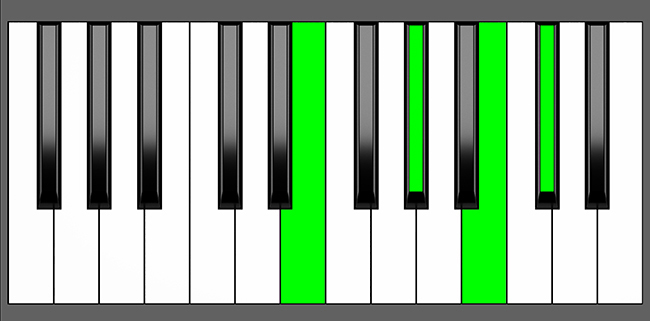
E6 is a four-note chord consisting of the notes E, G#, B, and C#. It is a major chord with an added sixth. It belongs to the chord family of “added tone chords” (aka “add chord”). Keep reading to gain a deeper understanding of the music theory behind this chord.
Structure of E6
Notes |
|---|
| E, G#, B, C# |
Intervals |
|---|
| R, 3, 5, 6 |
Finger Position
Left Hand |
|---|
| 5, 3, 2, 1
5, 4, 2, 1 |
Right Hand |
|---|
| 1, 2, 4, 5
1, 2, 3, 4 |
E6 Chord Inversions
The E6 chord has a total of 3 inversions:
| Root Position: | E | G# | B | C# |
| 1st Inversion: | G# | B | C# | E |
| 2nd Inversion: | B | C# | E | G# |
| 3rd Inversion: | C# | E | G# | B |
Piano Keyboard Diagrams
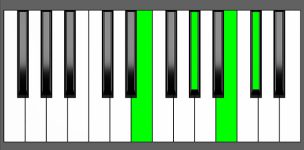
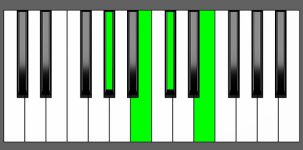
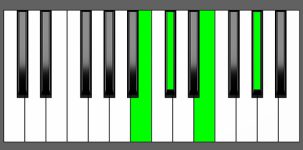
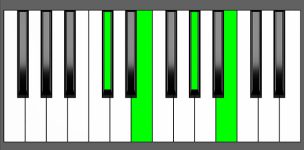
Music Theory and Harmony of E6
Building the E6 Chord: Different Approaches
Starting from the E Major Scale
To create a 6th chord, you can use the Major scale as a reference by combining a Root, a 3rd, a 5th, and a 6th.


Apply the formula R, 3, 5, 6 to build a 6th chord:
- Select the Root note, which is E.
- Pick the 3rd note, which is G#, and add it to the chord.
- Add the 5th note, which is B, and include it as well.
- Finally, add the 6th which is C#
by Combining Intervals
To build a 6th chord, one approach is to combine specific intervals, namely a major 3rd, a minor 3rd, and a major 2nd (a whole-tone).
3 + m3 + 2 = 6th chords
For instance, when building an E6 chord, you can observe that
- E-G# forms a major 3rd interval,
- G#-B creates a minor 3rd interval, and
- B-C# makes up a whole-tone interval.
By stacking these intervals together, you can form an E6 chord.
6th Chords Equivalencies
If we take the third inversion of a 6th chord (which means we move the notes around so that the 6th note becomes the Root note), we end up with a new chord that is equivalent to a min7 chord.
So, if we take the E6 chord (which has the notes E, G#, B, and C#) and move the notes around so that C# becomes the Root note, we end up with a new chord that is equivalent to a C# min7 chord (which has the notes C#, E, G#, and B).
3rd inversion of E6 = C# min7
How to Use E6 in a Chord Progression
Since 6th chords are based on major triads with an added sixth, they can substitute the major chords built on the scale of the root. This means we can use the E6 chord in those positions on the scale where the harmonization results in a major chord.
What makes the 6th special is that it is more stable and resolved than a major 7th. The Maj7 chord adds a leading-tone that sits a half step below the root and creates a gentle tension (and, when the root is in the melody, an unpleasant minor-2nd clash); the 6th has none of that. This is why the 6th is the classic tonic chord of swing, doo-wop, western swing and rockabilly, and why so many songs simply end on it. It gives a casual, laid-back, "finished" sound rather than the brighter, more modern edge of the Maj7.
This table shows the harmonized major and natural minor scales where the E Major chord is found. In every position where the E Maj7 chord appears, the E6 chord can be used as a variation. In every progression below the E6 is written on its own, exactly where you would play it; the green cell is always the E6 in context.
on Major Scales
| Major Scales | I | ii | iii | IV | V | vi | vii |
|---|---|---|---|---|---|---|---|
| E | E Maj7 ⇒ E6 | F# min7 | G# min7 | A Maj7 | B7 | C# min7 | D#m7b5 |
| B | B Maj7 | C# min7 | D# min7 | E Maj7 ⇒ E6 | F#7 | G# min7 | A#m7b5 |
- Tonic chord (I) in E Major
- Subdominant chord (IV) in B Major
on Natural minor Scales
| Minor Scales | i | ii | III | iv | v | VI | VII |
|---|---|---|---|---|---|---|---|
| C# | C# min7 | D#m7b5 | E Maj7 ⇒ E6 | F# min7 | G# min7 | A Maj7 | B7 |
| G# | G# min7 | A#m7b5 | B Maj7 | C# min7 | D# min7 | E Maj7 ⇒ E6 | F#7 |
- Mediant chord (III) in C# minor
- Submediant chord (VI) in G# minor
Why the 6th Sounds So Settled (6 vs Maj7)
The 6th and the major 7th are the two usual ways to enrich a plain major triad, but they pull in opposite directions. The major 7th (in E6's case, D#) is a leading-tone that sits a half step below the root, so a Maj7 chord always carries a faint, sweet tension. The 6th (C#) is a whole tone above the 5th and creates no such tension — the chord sounds completely at rest. When the melody lands on the root, a Maj7 produces a harsh minor-2nd clash between the 7th and the root, while a 6th stays smooth; this is exactly why traditional players reach for the 6th to end a tune.
There is a second, deeper reason the 6th sounds so consonant: E6 contains the same four notes as C# min7 (E, G#, B, C#). In other words a major 6 chord is the relative minor 7th in disguise — only the bass note decides which one you hear. With the root in the bass it is a warm E6; with the 6th (C#) in the bass it becomes C# min7. This kinship gives the 6th its gentle, slightly "happy-sad" color and makes it move very smoothly to and from the relative-minor chords in a key.
Voicing the E6 on Piano and Guitar
E6 has only four notes (E, G#, B, C#), so it is easy to grab, but a few voicing habits make it sing:
- Rootless (third–fifth–sixth). Drop the root and play G#, B, C#. A bass player or the left hand supplies the E, and the upper three notes keep the chord light — the standard jazz-piano approach.
- Drop the 5th. E, G#, C# alone is enough to state the chord; the 5th (B) is the most expendable note.
- Western-swing block chord. In western swing every major chord becomes a 6th, strummed in close four-note voicings and changed every two beats for that driving rhythm sound.
- The 6–to–minor slide. Because E6 equals C# min7, guitarists often grab a 6th shape and slide it up three frets to reach the relative minor, then walk it back — a signature western-swing and rockabilly move.
On guitar the 6th is a compact, movable shape that sits perfectly under swing, rockabilly and surf rhythm playing.
E6 Chord Function in Major and Minor Keys
Understanding Scale Degrees
When we harmonize a scale, we use the notes of the scale to create chords, so the notes of the chords are all found within the scale itself. Each note is assigned a degree that represents its position in the scale:
- Tonic (1st degree): the tonal center or home base, providing resolution and stability.
- Supertonic (2nd degree): often a passing tone or a bridge between the tonic and other degrees.
- Mediant (3rd degree): helps define the tonality (major or minor) and lies midway between tonic and dominant.
- Subdominant (4th degree): a contrasting or complementary harmony to the dominant.
- Dominant (5th degree): creates tension and expectation, resolved by returning to the tonic.
- Submediant (6th degree): lies midway between tonic and subdominant and often bridges the dominant and the tonic.
- Leading tone (7th degree): a half step below the tonic, creating a strong pull back to it.
E6 in E Major (as the I chord)
E6 replaces the plain E triad or E Maj7 as the tonic of E major. As the I chord it is the point of rest, so it shines wherever the harmony arrives or sits: the final chord of a cadence, the top of a doo-wop loop, or a swing tonic. It is the most natural home for a 6th chord.
| I | ii | iii | IV | V | vi | vii |
| E Maj7 ⇒ E6 | F# min7 | G# min7 | A Maj7 | B7 | C# min7 | D#m7b5 |
E6 as I degree – Chord Progressions
ii V I — the essential resolution
End a ii–V on a I6 for a settled, traditional-jazz cadence (smoother than a Maj7).
| ii | V | I |
| F# min7 | B7 | E6 |
ii bII7 I — tritone-sub ending (jazz colour)
Swap the B7 for its tritone substitute, F13: the bass slips down chromatically from the ii (F#), through bII7 (F), to the root E, while the guide tones (A and D#) stay put and melt onto E6.
| ii | bII7 | I |
| F# min7 | F13 | E6 |
I vi IV V — the 50s / doo-wop progression
The quintessential home of the 6th chord; the tonic is a 6 in a thousand doo-wop and swing tunes.
| I | vi | IV | V |
| E6 | C# min7 | A Maj7 | B7 |
I VI7b9 ii V — secondary dominant turnaround
Turn the diatonic vi (C# min7) into C#7b9, the secondary dominant of ii: its E# pulls up to the F# of F# min7, giving the loop a strong cyclic push.
| I | VI7b9 | ii | V |
| E6 | C#7b9 | F# min7 | B13 |
I vi ii V — doo-wop / turnaround variant
The subdominant swapped for ii, giving the ubiquitous turnaround that loops back to I6.
| I | vi | ii | V |
| E6 | C# min7 | F# min7 | B7 |
I IV V — rockabilly / blues cadence
Rockabilly leans on I–IV–V; making the tonic a 6 gives that classic twangy ending.
| I | IV | V |
| E6 | A Maj7 | B7 |
I IV I V — western-swing turnaround
In western swing every major chord becomes a 6th; here the I6 anchors a two-beat swing rhythm.
| I | IV | I | V |
| E6 | A6 | E6 | B7 |
I IV vi V — pop rotation
A common re-ordering of the doo-wop chords, keeping the 6th on the tonic.
| I | IV | vi | V |
| E6 | A Maj7 | C# min7 | B7 |
I V vi IV — pop progression
The modern four-chord loop; opening on a I6 gives it a warm, retro sheen.
| I | V | vi | IV |
| E6 | B7 | C# min7 | A Maj7 |
vi IV I V — tonic as landing
The same four chords rotated so the bright E6 is the arrival after the minor vi.
| vi | IV | I | V |
| C# min7 | A Maj7 | E6 | B7 |
E6 in B Major (as the IV chord)
In B major, E6 is the subdominant (IV). The IV is the "away from home" chord, and a 6th there is warm and relaxed without pulling hard, which makes it a natural fit for the plagal (IV–I) cadence and for swing and blues where the IV is a 6th too.
| I | ii | iii | IV | V | vi | vii |
| B Maj7 | C# min7 | D# min7 | E Maj7 ⇒ E6 | F#7 | G# min7 | A#m7b5 |
E6 as IV degree – Chord Progressions
IV I — plagal "amen" cadence
The subdominant melting home; a 6th IV makes the plagal move glow.
| IV | I |
| E6 | B Maj7 |
IV ivm I — borrowed minor-iv plagal
Slip a borrowed E min6 between E6 and B Maj7: the G# of E6 falls chromatically to G (in E min6) and then to F#, the 5th of B Maj7 — a lush modal-mixture plagal cadence. (E min6 is a passing colour here, not a 6th-chord substitute.)
| IV | ivm | I |
| E6 | Em6 | B Maj7 |
I IV V — rockabilly / blues, 6th subdominant
The IV as a 6th is a staple of rockabilly and swing rhythm playing.
| I | IV | V |
| B Maj7 | E6 | F#7 |
I IV I V — western-swing turnaround
Both I and IV as 6ths, changed every two beats — the western-swing sound.
| I | IV | I | V |
| B6 | E6 | B6 | F#7 |
I vi IV V — doo-wop, 6th on the IV
The 50s progression with the subdominant colored as a 6th.
| I | vi | IV | V |
| B Maj7 | G# min7 | E6 | F#7 |
I V vi IV — pop, 6th as the final IV
The pop loop landing on a colorful subdominant.
| I | V | vi | IV |
| B Maj7 | F#7 | G# min7 | E6 |
I IV vi V — pop rotation
E6 sits between tonic and the minor vi for a smooth inner motion.
| I | IV | vi | V |
| B Maj7 | E6 | G# min7 | F#7 |
E6 in C# minor (as the III chord)
In C# minor, E6 sits on the third degree — the relative major. This is a especially natural spot for a 6th, because E6 literally shares its notes with C# min7 (the tonic of the key): the two chords are the same four notes with a different bass. That kinship makes the III6 slide in and out of the tonic with beautifully smooth voice-leading.
| i | ii | III | iv | v | VI | VII |
| C# min7 | D#m7b5 | E Maj7 ⇒ E6 | F# min7 | G# min7 | A Maj7 | B7 |
E6 as III degree – Chord Progressions
i III — tonic to its relative major
The clearest way to hear the III6: straight from C# min7, with which it shares every note.
| i | III |
| C# min7 | E6 |
III VII i — relative-major approach home
Open on the bright E6, fall through VII, land on the minor tonic.
| III | VII | i |
| E6 | B7 | C# min7 |
i VI III VII — epic minor loop
A cinematic four-chord loop; the III6 is its shining moment.
| i | VI | III | VII |
| C# min7 | A Maj7 | E6 | B7 |
i VI III6 ii V — walking-bass inversion
Put E6 in first inversion (E6/G#) and add a passing F# min7: the bass now walks smoothly C#–A–G#–F#–B instead of leaping, giving an elegant line into the cadence.
| i | VI | III6 | ii | V |
| C# min7 | A Maj7 | E6/G# | F# min7 | B7 |
i III VII VI — descending minor loop
The E6 lands right after the tonic for an immediate major lift.
| i | III | VII | VI |
| C# min7 | E6 | B7 | A Maj7 |
Circle Progression
The 6th as III inside a full circle-of-fifths run back to the tonic.
| i | iv | VII | III | VI | ii | V7 | i |
| C# min7 | F# min7 | B7 | E6 | A Maj7 | D#m7b5 | G#7 | C# min7 |
E6 in G# minor (as the VI chord)
In G# minor, E6 is the submediant (VI) — one of the most-used resting points in minor-key pop, rock and film music. Placing a 6th there gives a warm, relaxed swell, and it is a natural "color" chord in the extremely common i–VI–VII and i–VII–VI loops.
| i | ii | III | iv | v | VI | VII |
| G# min7 | A#m7b5 | B Maj7 | C# min7 | D# min7 | E Maj7 ⇒ E6 | F#7 |
E6 as VI degree – Chord Progressions
i VI VII — the classic minor climb
The bread-and-butter minor loop; the VI6 is its warm emotional centre.
| i | VI | VII |
| G# min7 | E6 | F#7 |
i VI ii7/V V — softened pre-dominant
Extend the pre-dominant by inserting C# min7 over an F# bass (C#m7/F#) before the F#7: it softens the leap into the dominant and keeps F# pedaling underneath.
| i | VI | ii7/V | V |
| G# min7 | E6 | C#m7/F# | F#7 |
VI VII i — rising resolution to the tonic
The E6 launches an upward VI–VII–i with real momentum.
| VI | VII | i |
| E6 | F#7 | G# min7 |
i v VI VII — extended minor loop
A longer minor climb; the VI6 glows before the VII pushes on.
| i | v | VI | VII |
| G# min7 | D# min7 | E6 | F#7 |
i VII VI VII — Aeolian rock vamp
The 6th as the warm VI inside a descending Aeolian vamp.
| i | VII | VI | VII |
| G# min7 | F#7 | E6 | F#7 |
i III VII VI — the 6th as the final lift
A four-chord loop ending on the submediant 6th, leaving the door open.
| i | III | VII | VI |
| G# min7 | B Maj7 | F#7 | E6 |
Circle Progression
The 6th as VI inside a full circle-of-fifths return to the tonic.
| i | iv | VII | III | VI | ii | V7 | i |
| G# min7 | C# min7 | F#7 | B Maj7 | E6 | A#m7b5 | D#7 | G# min7 |
Signature 6th-Chord Progressions Across Styles
More than the 6/9 or the Maj7, the plain 6th is tied to specific historical styles. These are the moves where it truly belongs, each shown here in the home key.
The swing-era / jazz ending: ii V I6
The most common practical use of a 6th: land a ii–V on a I6 as the very last chord. It ends the tune warm and fully resolved — the traditional-jazz alternative to a Maj7 ending, and the reason so many swing tunes finish on a 6.
| ii | V | I6 |
| F# min7 | B7 | E6 |
Doo-wop / 50s: I vi IV V
The "Heart and Soul" / "Stand by Me" changes. The 6th is the sound of this era; keep the tonic (and often the IV) as 6ths for authentic doo-wop warmth.
| I | vi | IV | V |
| E6 | C# min7 | A Maj7 | B7 |
Western swing: all majors become 6ths
Rule number one of western-swing comping: every major chord is played as a 6th, changed every two beats. Here a simple I–IV–V is all 6ths.
| I6 | IV6 | I6 | V |
| E6 | A6 | E6 | B7 |
The 6-to-relative-minor slide
Because E6 = C# min7, you can slide a 6th shape up three frets to its relative minor and back — a classic western-swing and rockabilly fill that stays on one harmony.
| I6 | vi7 | I6 |
| E6 | C# min7 | E6 |
Rockabilly / blues I IV V with 6ths
Rockabilly rides the I–IV–V blues frame; 6th chords give it that bright, twangy period sound, especially as the final chord.
| I6 | IV6 | V | I6 |
| E6 | A6 | B7 | E6 |
Alternative Names for E6 Chord
- Mi 6
- E 6th
- E M6
- E sixth
- E add6
- E Maj6
- E major6
- E major 6th
- E major sixth
- E major add 6th