Piano Diagram of Ebm6 in Root Position
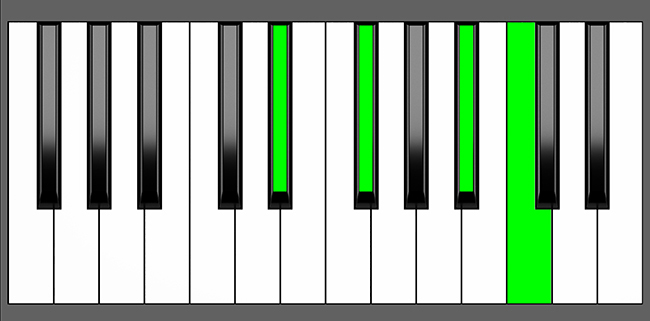
The Ebm6 is a chord made up of four notes Eb, Gb, Bb, and C. It’s the minor chord built on the key of Eb with an added major 6th interval (C). It belongs to the chord family of “added tone chords” (aka “add chord”) because it has an extra tone added to a minor triad. In this article, we’ll take a closer look at the music theory behind this chord.
Structure of Ebm6
Notes |
|---|
| Eb, Gb, Bb, C |
Intervals |
|---|
| R, m3, 5, 6 |
Finger Position
Left Hand |
|---|
| 5, 3, 2, 1
5, 4, 2, 1 |
Right Hand |
|---|
| 1, 2, 4, 5
1, 2, 3, 4 |
Ebm6 Chord Inversions
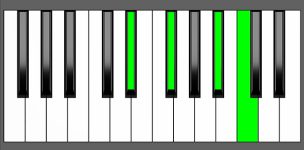
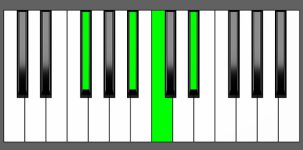
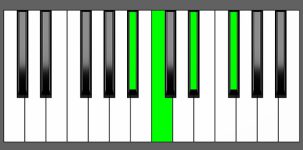
The Ebm6 chord has a total of 3 inversions:
| Root Position: | Eb | Gb | Bb | C |
| 1st Inversion: | Gb | Bb | C | Eb |
| 2nd Inversion: | Bb | C | Eb | Gb |
| 3rd Inversion: | C | Eb | Gb | Bb |
Piano Keyboard Diagrams
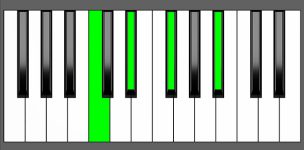
Ebm6 Chord Equivalencies
Rearranging the notes of a chord can lead to interesting and unique chord equivalencies. This is especially true for 6th chords, as we can create a different type of chord by rearranging the notes of a minor 6th chord in a specific way.
If we take the 3rd inversion of a minor 6th chord, where the 6th note becomes the root note, we end up with a minor 7th flat 5th chord (also known as a half-diminished chord).
For example, let’s take the Ebm6 chord, which consists of the notes Eb, Gb, Bb, and C. By rearranging the notes so that C becomes the root note, we get a Cm7b5 chord with the notes C, Eb, Gb, and Bb.
3rd Inversion of Ebm6 = Cm7b5
The reason why the 3rd inversion of a minor 6th chord results in a minor 7th flat 5th chord is due to the note relationships between the chords. When we move the 6th note to become the root note, we end up with a chord that has a minor 3rd, diminished 5th, and a minor 7th interval. These intervals are the same as a m7b5 chord.
Also, note that the 3rd inversion of a minor 6th chord is a dominant 9th chord without root. Ebm6 3rd inversion is C, Eb, Gb, Bb which could be considered also an Ab9 (Ab, C, Eb, Gb, Bb) without the root.
Music Theory and Harmony of Ebm6
An Eb minor 6th chord consists of four notes, an Eb minor triad, plus a 6th interval. Due to the inclusion of the major sixth interval, represented by the note C, the Eb minor 6th chord generates a sense of tension that can either be resolved by transitioning to a more stable chord or utilized to create a feeling of “uncertain stability.”
Building the Ebm6 Chord: Different Approaches
Starting from the Eb Major Scale
To build a minor 6th chord, you would include the root note, minor third, fifth, and sixth from a minor scale.
However, when teaching this concept, it can be more effective to demonstrate its construction using a major scale. This is because a major scale better illustrates the relationship between intervals and their respective qualities.
For instance, to build the Ebm6 chord, you can start with the Eb Major scale:


To create an Ebm6 chord, apply the formula R, m3, 5, 6 in the following manner:
- Begin with the Root note, Eb.
- Select the 3rd interval G then lower it down by a half-tone to get the minor 3rd, Gb.
- Include the 5th note, which is Bb, to the chord.
- Finally, add the 6th interval, C.
By following this simple formula, you can create a minor 6th chord from any major scale.
by Combining Intervals
One method to create a minor 6th chord is by combining specific intervals – a minor 3rd, a major 3rd, and a major 2nd (a whole-tone).
m3 + 3 + 2 = minor 6th Chords
To illustrate, let’s use the Ebm6 chord as an example: by examining the intervals between the notes, we can see that
- Eb-Gb is a minor 3rd interval,
- Gb-Bb is a major 3rd interval,
- and Bb-C is a whole-tone interval.
These three intervals can be stacked together to create the Ebm6 chord.
How to Use Ebm6 in a Chord Progression
The minor 6th chord is most at home as a tonic minor chord, where it replaces a plain minor triad or a minor 7th to give a stronger sense of arrival. Its major 6th belongs to the Dorian mode, so the chord fits naturally over a Dorian or melodic-minor tonic. When the surrounding music is based on the natural minor scale instead, that 6th sits outside the scale and needs to be handled with more care, as the sections below show.
on Natural minor Scales
| Minor Scales | i | ii | III | iv | v | VI | VII |
|---|---|---|---|---|---|---|---|
| Eb | Eb min7 ⇒ Ebm6 | Fm7b5 | Gb Maj7 | Ab min7 | Bb min7 | Cb Maj7 | Db7 |
| Bb | Bb min7 | Cm7b5 | Db Maj7 | Eb min7 ⇒ Ebm6 | F min7 | Gb Maj7 | Ab7 |
| Ab | Ab min7 | Bbm7b5 | Cb Maj7 | Db min7 | Eb min7 ⇒ Ebm6 | Fb Maj7 | Gb7 |
- Tonic minor chord in Eb minor
- Subdominant chord in Bb minor
on Major Scales
| Major Scales | I | ii | iii | IV | V | vi | vii |
|---|---|---|---|---|---|---|---|
| Db | Db Maj7 | Eb min7 ⇒ Ebm6 | F min7 | Gb Maj7 | Ab7 | Bb min7 | Cm7b5 |
| Cb | Cb Maj7 | Db min7 | Eb min7 ⇒ Ebm6 | Fb Maj7 | Gb7 | Ab min7 | Bbm7b5 |
| Gb | Gb Maj7 | Ab min7 | Bb min7 | Cb Maj7 | Db7 | Eb min7 ⇒ Ebm6 | Fm7b5 |
- Supertonic (ii) chord in Db major
- Borrowed subdominant (iv6) in Bb major
Non-diatonic positions
Whether the Eb minor 6th is diatonic depends on the scale in use. Its C belongs to Eb Dorian and Eb melodic minor, so in those contexts the chord is fully diatonic and works as a natural tonic minor. In the Eb natural minor scale, however, the 6th degree is Cb, not C, so relative to that scale the chord is non-diatonic. The same is true of the Gb major scale, which contains Cb rather than C.
In a natural-minor setting, then, the C can clash with a melody or bass line that uses Cb. This is not a flaw: it is the reason the chord sounds distinctive. It simply means the 6th should be treated as a deliberate color, checked against the melody rather than added by default.
Ebm6 Function in Major and Minor Keys
Understanding Scale Degrees
Scale degrees are essential for understanding the relationship between the notes in a scale and how they function within chords. The diatonic major scale consists of seven degrees, each with its unique role in creating the overall harmony of the scale.
- The first degree of the scale is known as the Tonic, which serves as the anchor for the music. It establishes a stable tonal center that acts as the foundation for the scale.
- The second degree is called the Supertonic, often used as a transitional note between the Tonic and other notes in the scale. It creates a sense of motion within the melody or harmony.
- The third degree of the scale is the Mediant, which sits halfway between the Tonic and Dominant notes. It helps establish whether the scale is major or minor.
- The fourth degree is called the Subdominant, used to complement the Dominant and add tension and resolution to the music.
- The fifth degree is the Dominant, which creates tension and anticipation within the melody or harmony, typically resolved by returning to the Tonic.
- The sixth degree is the Submediant, often employed as a transitional note between the Dominant and Tonic, adding a sense of stability and restfulness to the music.
- The seventh degree is the Leading tone, located one half-step below the Tonic. It creates a strong sense of tension and a desire to resolve to the Tonic, frequently used to create a sense of resolution and finality in the melody or harmony.
Ebm6 as the Tonic Minor in Eb minor
As the tonic chord in Eb minor, the Ebm6 is one of the most idiomatic choices available. In jazz, bossa nova, and older popular standards it regularly replaces a plain Eb minor triad or an Ebm7 as the home chord, because its major 6th gives a clear sense of arrival without sounding like a ii chord waiting to move to a dominant. The chord takes its C from Eb Dorian and Eb melodic minor, so it belongs to the tonic-minor family rather than being an outside color.
Relative to the Eb natural minor scale the C is a non-scale tone, so if the melody or bass leans on Cb you have a choice to make between the two notes. In practice the tonic Ebm6 sound usually implies a Dorian or melodic-minor context around it. The classic way to introduce it is the tonic minor line cliché, moving a single inner voice down by half steps while the rest of the chord stays put.
| i | ii | III | iv | v | VI | VII |
| Eb min7 ⇒ Ebm6 | Fm7b5 | Gb Maj7 | Ab min7 | Bb min7 | Cb Maj7 | Db7 |
Ebm6 Chord Progressions as i degree
The following progressions show the Eb minor 6th chord as the tonic (i degree). The line cliché below is the same device that opens “My Funny Valentine” and drives “In a Sentimental Mood”: the top voice descends Eb – D – Db – C over a held Eb minor chord, ending on the Ebm6. In gypsy jazz it is the default tonic minor sound. The voicings in brackets are only suggestions.
Andalusian cadence (i VII VI V)
The descending i–VII–VI–V is one of the most recognisable minor progressions. Voicing the tonic as a 6th chord gives the opening a warm, settled colour before the line steps down to the dominant.
| i | VII | VI | V |
| Ebm6 | Db | Cb Maj7 | Bb7 |
Tonic minor line cliché (i → iΔ → i7 → i6)
| i | iΔ | i7 | i6 |
| Eb min | Eb min(Maj7) | Eb min7 | Eb min6 |
Minor cadence (i iv V i)
A complete minor cadence: the tonic 6th moves through the subdominant to a true dominant (with the leading tone) and back home. The V7 gives a much stronger pull to the tonic than a minor v would.
| i | iv | V | i |
| Ebm6 | Ab min7 | Bb7 | Ebm6 |
Line cliché resolving to iv
The line cliché is rarely static: it usually leads somewhere. A common resolution moves it to the iv chord, as in “In a Sentimental Mood”, where the descending inner voice lands on the third of the iv chord.
| i | i7 | i6 | iv |
| Eb min | Eb min7 | Ebm6 | Ab min7 |
Minor turnaround (i VI ii V)
The i–VI–ii–V turnaround is one of the most common in minor keys. Voicing the tonic as a 6th chord gives it a clear point of arrival.
| i | VI | ii | V |
| Ebm6 | Cb7 | Fm7b5 | Bb7b9 |
Minor turnaround with bIII (i bIII ii V)
Passing through the relative major (bIII) connects the tonic to the ii chord smoothly. This i–bIII–ii–V is a staple minor turnaround in the jazz idiom.
| i | bIII | ii | V |
| Ebm6 | Gb Maj7 | Fm7b5 | Bb7b9 |
Ebm6 as the Subdominant in Bb minor
In the key of Bb minor, the Ebm6 works as the subdominant (iv) chord. This is a natural place for a minor 6th: the tonic minor line cliché in jazz standards often moves from the tonic minor down to the iv chord, and a iv6 gives that arrival point the same bright, stable quality it has on the tonic. The C in the chord is the 2nd degree of Bb minor, so it sits comfortably against the key.
| i | ii | III | iv | v | VI | VII |
| Bb min7 | Cm7b5 | Db Maj7 | Eb min7 ⇒ Ebm6 | F min7 | Gb Maj7 | Ab7 |
Ebm6 Chord Progressions as iv degree
The following chord progressions feature an Ebm6 chord as the subdominant (iv degree):
i iv V i
Here the Ebm6 is the subdominant of the cadence. Using a dominant 7th on the V (rather than a minor v) gives the leading tone and a strong resolution back to the tonic.
| i | iv | V | i |
| Bb min7 | Ebm6 | F7 | Bb min7 |
Minor cadence (iv6 V i)
In minor keys the motion from iv6 to V is a strong cadence: the major 6th of the iv6 rises by a half step to the third of the dominant. This is one of the oldest and most reliable uses of the chord.
| iv | V | i |
| Ebm6 | F7 | Bb min7 |
Minor ii V i with iv6 approach
Placing the iv6 before the ii–V gives a smooth stepwise descent into the cadence, a common way to set up the turnaround in a minor key.
| iv | ii | V | i |
| Ebm6 | Cm7b5 | F7 | Bb min7 |
Ebm6 as a Borrowed iv6 in Bb Major
One of the most common real-world uses of a minor 6th chord in a major key is the move from IV to iv, where the major subdominant is briefly replaced by its minor version. This borrowed iv chord is often voiced as a minor 6th. In the key of Bb major, the subdominant is Eb, so an Ebm6 works as a borrowed iv6, taken from Eb minor.
This IV → iv motion is a staple of pop and jazz. You can hear it in “Somewhere Over the Rainbow” and in the Beatles’ “The Long and Winding Road”, where the shift to the minor subdominant adds a sudden wistful pull just before the harmony settles back to the tonic. The chord does not resolve like a dominant; it colors the return home.
| I | ii | iii | IV ⇒ iv | V | vi | vii |
| Bb Maj7 | Cm7 | Dm7 | Eb Maj7 ⇒ Ebm6 | F7 | Gm7 | Am7b5 |
Ebm6 as a Borrowed iv6 – Chord Progressions
The following progressions show the IV → iv motion in Bb major, with the minor subdominant voiced as an Ebm6.
I IV iv I
| I | IV | iv | I |
| Bb Maj7 | Eb Maj7 | Ebm6 | Bb Maj7 |
I vi IV iv
| I | vi | IV | iv |
| Bb Maj7 | Gm7 | Eb Maj7 | Ebm6 |
I IV iv vi V
| I | IV | iv | vi | V |
| Bb Maj7 | Eb Maj7 | Ebm6 | Gm7 | F7 |
IV iv6 I (chromatic inner voice)
The classic modal-interchange move: the major subdominant becomes minor, and the sixth of the iv6 falls by half step into the tonic. You can hear this colour in songs like “The Long and Winding Road”.
| IV | iv6 | I |
| Eb Maj7 | Ebm6 | Bb Maj7 |
iv6 as a ii substitute (ii V I)
Minor 6th chord on the fourth degree can stand in for the ii in a major cadence, adding a subdominant-minor colour. This substitution appears in standards such as Cole Porter’s “Night and Day”.
| iv6 | V | I |
| Ebm6 | F7 | Bb Maj7 |
Ebm6 as the ii Chord in Db Major
The Ebm6 can also appear as the supertonic (ii) chord in Db major. Here it works as a colored ii chord leading into the dominant, a variant of the familiar ii–V–I. The added 6th (C) is the major 7th of Db, so it keeps the chord tied to the key while giving the ii a fuller, more open sound than a plain minor triad.
Note that this use overlaps with the tonic-minor sound: an Ebm6 heard as ii of Db and an Ebm6 heard as the tonic of Eb minor share the same notes, so context and bass motion decide which one the ear hears.
| I | ii | iii | IV | V | vi | vii |
| Db Maj7 | Eb min7 ⇒ Ebm6 | F min7 | Gb Maj7 | Ab7 | Bb min7 | Cm7b5 |
Ebm6 Chord Progressions as ii degree
Try playing the following chord progressions to better understand how the Ebm6 chord functions as the supertonic (ii) chord in the key of Db major.
ii V I
| ii | V | I |
| Eb min6 | Ab7 | Db Maj7 |
iii vi ii V I
The extended turnaround iii–vi–ii–V–I keeps the Ebm6 in its supertonic role while cycling through the diatonic chords back to the tonic. It is a common way to fill a turnaround bar without losing the ii–V pull.
| iii | vi | ii | V | I |
| F min7 | Bb min7 | Ebm6 | Ebm7 | Ab7 | Db Maj7 |
Line cliché over a ii V (Groovin’ High)
The line cliché also works on the ii chord of a ii–V. In “Groovin’ High”, the ii–V (here ii7–V7) is realised by walking the ii chord down through min(maj7), min7 and min6, turning a static bar into moving inner voices before the dominant.
| ii | ii7 | ii6 | V | I |
| Eb min | Eb min7 | Ebm6 | Ab7 | Db Maj7 |
Ebm6 in Other Positions
Beyond its main roles as a tonic minor, a subdominant, a borrowed iv, and a colored ii, the Ebm6 can appear on other scale degrees, but these uses are far less common in real music. On the mediant of Cb major or the submediant of Gb major, for example, the chord’s C lies outside the key, so it functions as a passing chromatic color rather than a stable harmony.
In practice, most composers reach for a plain minor 7th in those positions and keep the minor 6th for the tonic-minor and subdominant sounds, where its major 6th does clear harmonic work. If you do use an Ebm6 as a chromatic passing chord, treat the C as a deliberate voice-leading choice and check it against the melody.
Alternative Nomenclature for Ebm6
- Eb -6
- Mib -6
- Mib m6
- Eb m6th
- Eb min6
- Mib min6
- Eb m(add6)
- Eb min add 6
- Eb minor 6th
- Eb minor sixth
Conclusion
The progressions in this article cover the most common and idiomatic uses of the Eb minor 6th chord: as a tonic minor, as a subdominant, as a borrowed iv in a major key, and as a colored ii. The same chord supports more advanced treatments, including modal harmony, secondary dominants and substitutions, modal interchange, and voice leading, which build directly on the functions shown here.